


A New Life


In an industry that talks a lot about heritage and whose mechanical products are no longer an everyday necessity in a digital world, nostalgia has become a genuine business driver. Amida is the most recent example of this trend.
Digitrend, an icon of the 1970s
There’s a genuine rush to relaunch historic watch brands, and Amida stands out as one of the most striking recent examples. The brand has been revived by Matthieu Allègre, Clément Meynier, and Bruno Herbet. Matthieu Allègre, who founded his own design studio at the age of 27 after a few years working with several others, has collaborated with an impressive list of brands, including Louis Vuitton, Chopard, Movado, Perrelet, Piaget, Jacob & Co., and Corum. Clément Meynier brings to the Amida team entrepreneurial expertise from Depancel, a brand known for its ultra-affordable motorsport chronographs. Bruno Herbet brings the technical know-how gained from his experience at Daniel Roth, Gérald Genta, Jaeger-LeCoultre, Vacheron Constantin and Orkos.
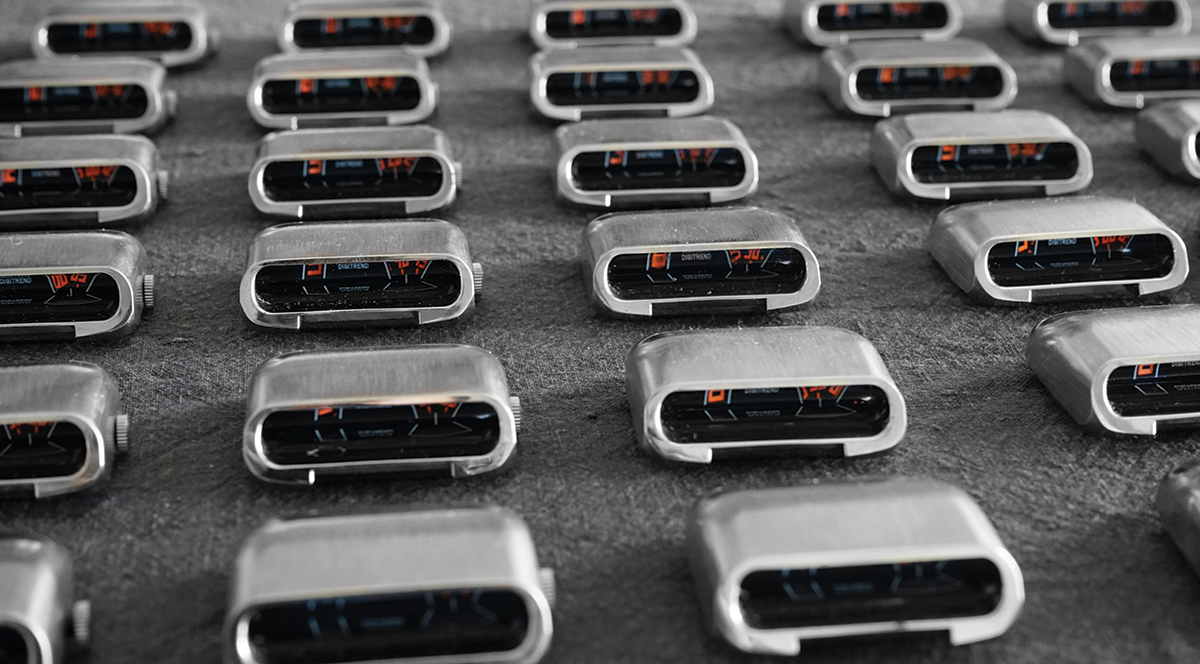
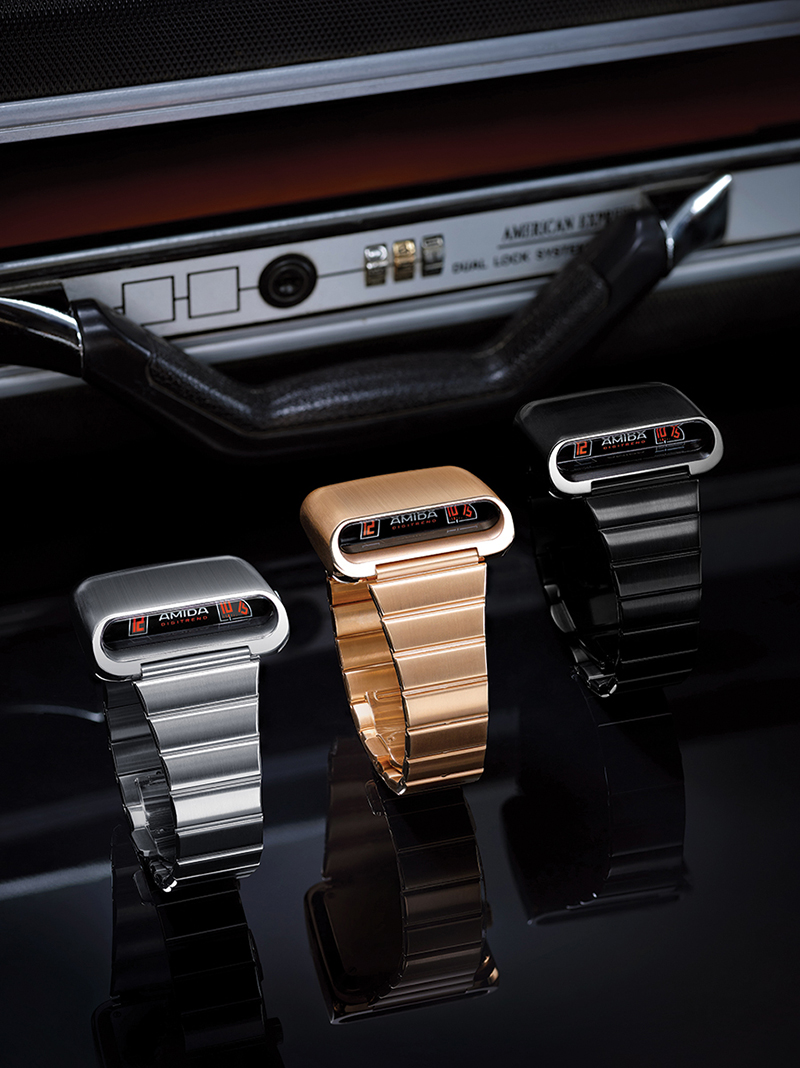
Allègre, Meynier, and Herbet are bringing the Amida brand back into the spotlight with the relaunch of a 1970s benchmark model: the Digitrend. First unveiled at Baselworld in 1976 – almost half a century ago – the watch was regarded as a model of the future: a hybrid design that combined the aesthetic of a sports car dashboard with an LED display system and classic mechanics. The automatic movement featured a jumping hour module, while the digital-style display was actually achieved using a prism that projected the hour and minute numerals vertically, forming images similar to those produced by a periscope. The display system – patented in 1973 by Zeno Hurt for Robert Triebold – ingeniously replicated the LED technology that had appeared in 1962, the difference being that Hurt’s display used only conventional mechanical and optical methods. The watch provided perfect legibility, whether the wearer was driving a car or flying an aircraft.
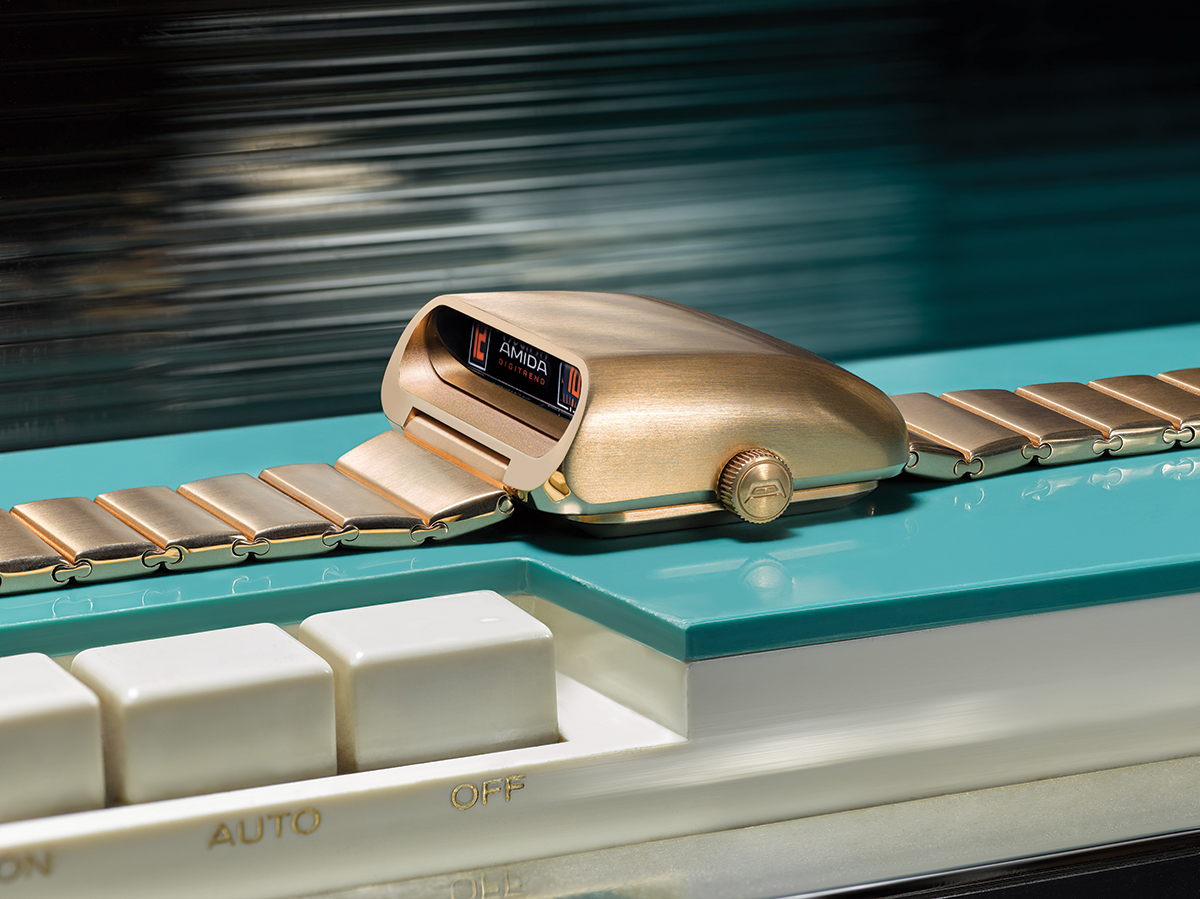
The success of the Digitrend stemmed from its status as a symbol of an era of immense effervescence and spectacular progress. Launched at the height of the Space Age and on the brink of the computer revolution, it coincided with a creative boom in the electronics and automotive industries. It was a time when the rise of more and more synthetic materials was opening up new opportunities for designers, and quartz was radically transforming the watchmaking industry. The Digitrend embodied the desire to look to the future while staying true to the principles of classic watchmaking.
The reincarnation of an ingenious idea
But the Digitrend has remained a point of reference not only for collectors, but also for designers. It has directly inspired some of the most spectacular models released by MB&F and Urwerk. And, at one point, it caught the eye of Matthieu Allègre: ‘I discovered Amida as a brand through a friend almost 10 years ago. I just fell in love with the Digitrend and its disruptive, retro-futuristic style. Then, as a designer, I immediately thought about the variety of possibilities this watch could offer: in terms of style, but above all in terms of the obvious link with the automotive world. That was even before I realised that it had already inspired other independent brands. Later, as I delved into the brand’s history, I went from discovery to discovery, delighting in every clue like a researcher. Until it became an obsession.’

Allègre made the decision to relaunch the brand, and in 2020 he was joined in this venture by Bruno Herbet and Clément Meynier. ‘As an entrepreneur in the watchmaking world,’ says Meynier, ‘it’s an incredible opportunity for me to be able to relaunch a historic and pioneering brand – and one of the first to have this vision of a watch, not as a mere functional object, but as an object of art and mechanical design.’
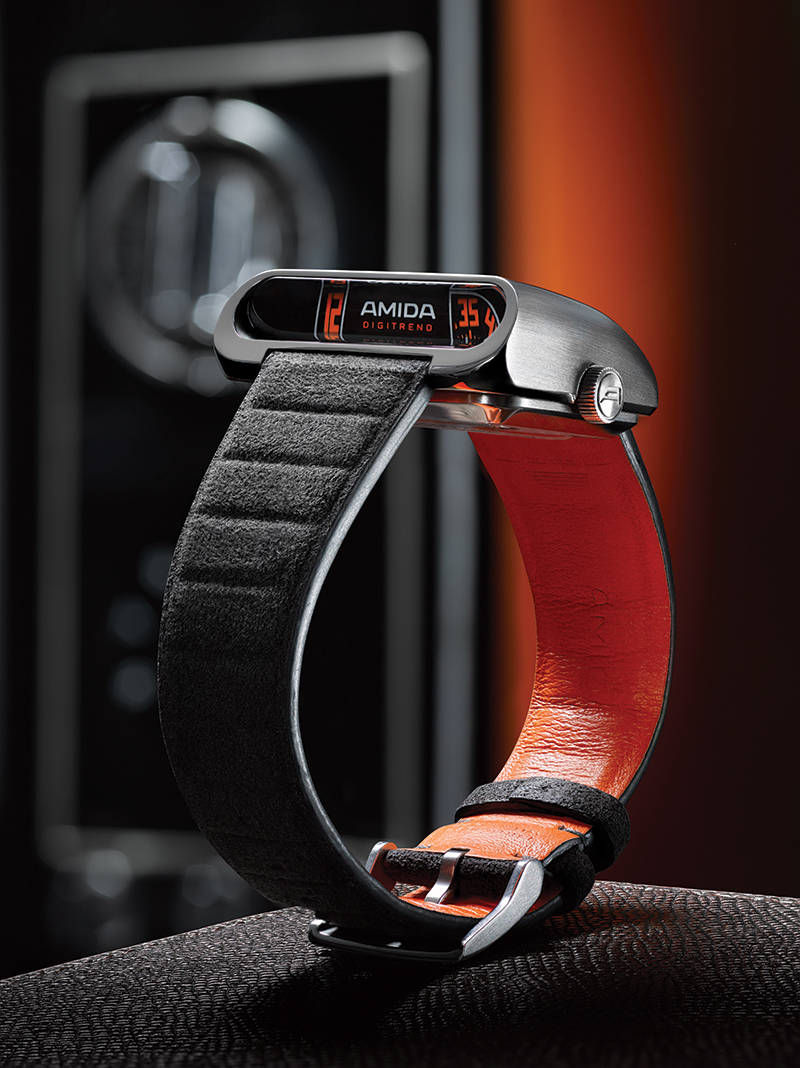
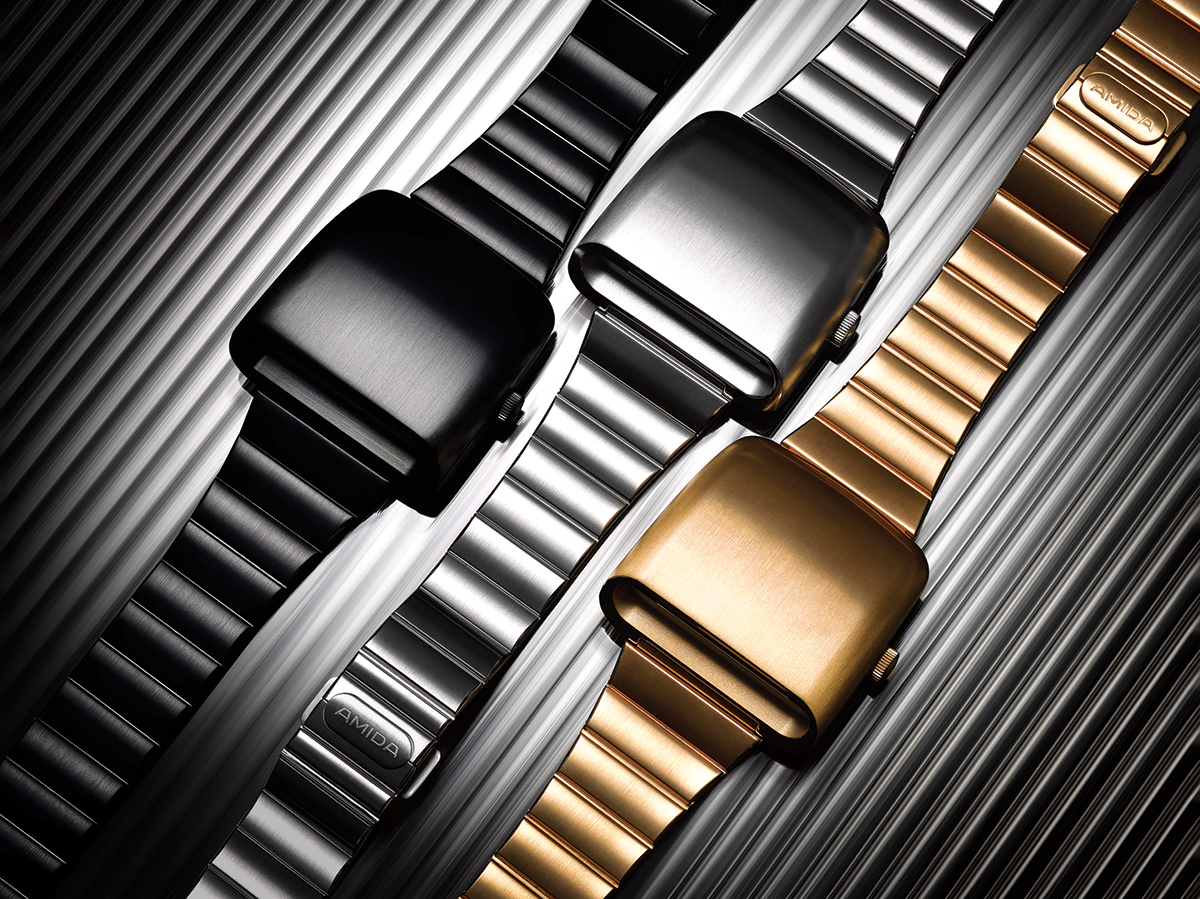
If the Digitrend was considered an unconventional watch at the time of its original launch, how does it look and feel today? Its design has been subtly updated for an even more ergonomic profile, with superior finishes and redesigned key details, such as the minute aperture and the numerals. The first edition, released last year by the trio Allègre-Meynier-Herbet, featuring a stainless-steel case (39 x 36 x 15.6mm), a self-winding movement with a 44-hour power reserve (Soprod Newton P092), and an Alcantara and calfskin strap, is priced at CHF 2,900 (excluding VAT). Two other editions have since followed, also with steel cases: one coated in black DLC (CHF 3,250), and the other in a gold finish (CHF 3,500). For an additional CHF 350, each version can be purchased with a matching steel bracelet. In my opinion, the watch is every bit as captivating today as it was when it was first launched, in 1976. It is a chapter of watchmaking history brought into the present – but it is more than that. Seductive and anachronistic at the same time, it is an eye-catching, ingenious, and beautifully conceived piece of design. It is bound to attract as many fans as ever.
Share this article


LEAVE A COMMENT
You must be logged in to post a comment.