



Cartier Privé Collection: The Santos Dumont


Cartier’s design vocabulary finds its most expressive form in the new Santos‑Dumont Obsidian, a watch that embodies the unified codes now defining Cartier’s long‑term aesthetic: yellow‑gold architecture, gold‑plated dials, apple‑shaped hands in blued steel, and the purity of a manual‑winding movement. Even the caseback engraving—an outline of the watch’s own case—signals Cartier’s shift from the logic of limited editions to a lasting, collectible canon.
The new Santos‑Dumont Obsidian centers its identity on the dial: Cartier uses Mexican obsidian, gold‑plated and ground to an astonishing thickness of only 0.3 millimeters. Natural air inclusions within the stone create an iridescent shimmer that changes with the light, ensuring each dial is unique. Working obsidian at this scale is notoriously difficult; its brittleness resembles glass, and the grinding process demands extreme precision to avoid micro‑fractures. The result is a dial that feels alive and organic, contrasting with the strict geometry of the Santos case.
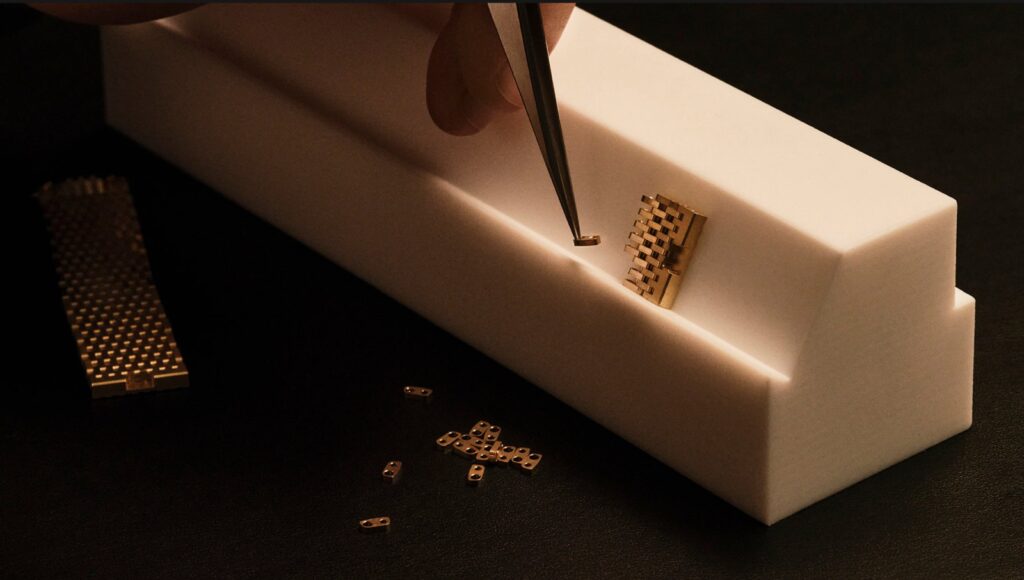
Cartier pairs this dial with a newly engineered bracelet inspired by the flexible metal bands of the 1920s. It consists of 394 individual links arranged in 15 rows, each link measuring 1.15 millimeters thick. The construction produces a drape more reminiscent of fabric than metal, eliminating the stiffness associated with traditional bracelets. The tactile sensation is closer to silk than steel, a technical achievement in micro‑engineering that redefines how a precious‑metal bracelet can feel on the wrist.
Inside the case beats the caliber 430 MC, a manual‑winding movement known for its slim profile and reliability. Operating at 21,600 vph, the movement’s compact dimensions allow the Santos‑Dumont to maintain its refined proportions while preserving the historical spirit of early wristwatches. Its architecture supports Cartier’s pursuit of thin, elegant cases without compromising mechanical integrity.



Cartier expands the Santos‑Dumont line with two new LM models in yellow gold and steel‑and‑gold, both featuring satin sunray‑brushed dials. These variants reinforce the lineage that began in 1904 with the original Santos‑Dumont—widely recognized as the first purpose‑built modern wristwatch. The hallmarks remain: elongated Roman numerals, exposed screws on the bezel, and the round crown capped with a blue cabochon. These elements form a visual through‑line connecting the earliest aviation‑era wristwatch to its contemporary descendants.
To deepen the understanding of this new Obsidian model, three dimensions of Cartier’s craft reveal how the watch bridges heritage and innovation. The movement architecture of the 430 MC shows Cartier’s commitment to ultra‑thin manual calibers, where the balance assembly, gear train, and barrel are arranged to minimize height while maintaining stability. The obsidian‑dial manufacturing process highlights the challenge of slicing and polishing volcanic glass to microscopic tolerances without compromising its natural inclusions. And the historical evolution of the Santos traces how the original 1904 design—created for aviator Alberto Santos‑Dumont—established the blueprint for the modern wristwatch: a square case, visible screws, and a form‑follows‑function philosophy that remains intact today.
Cartier’s new Santos‑Dumont Obsidian stands as a synthesis of these three pillars. Its natural‑stone dial, historically inspired bracelet, and refined manual movement position it as a bridge between Cartier’s artisanal past and its newly codified permanent collection. By elevating materials and craftsmanship while standardizing aesthetic codes, Cartier signals a future in which its most iconic shapes—Tank, Cloche, Cintrée, Santos—are not fleeting limited editions but enduring pillars of contemporary watchmaking.
Share this article




LEAVE A COMMENT
You must be logged in to post a comment.