


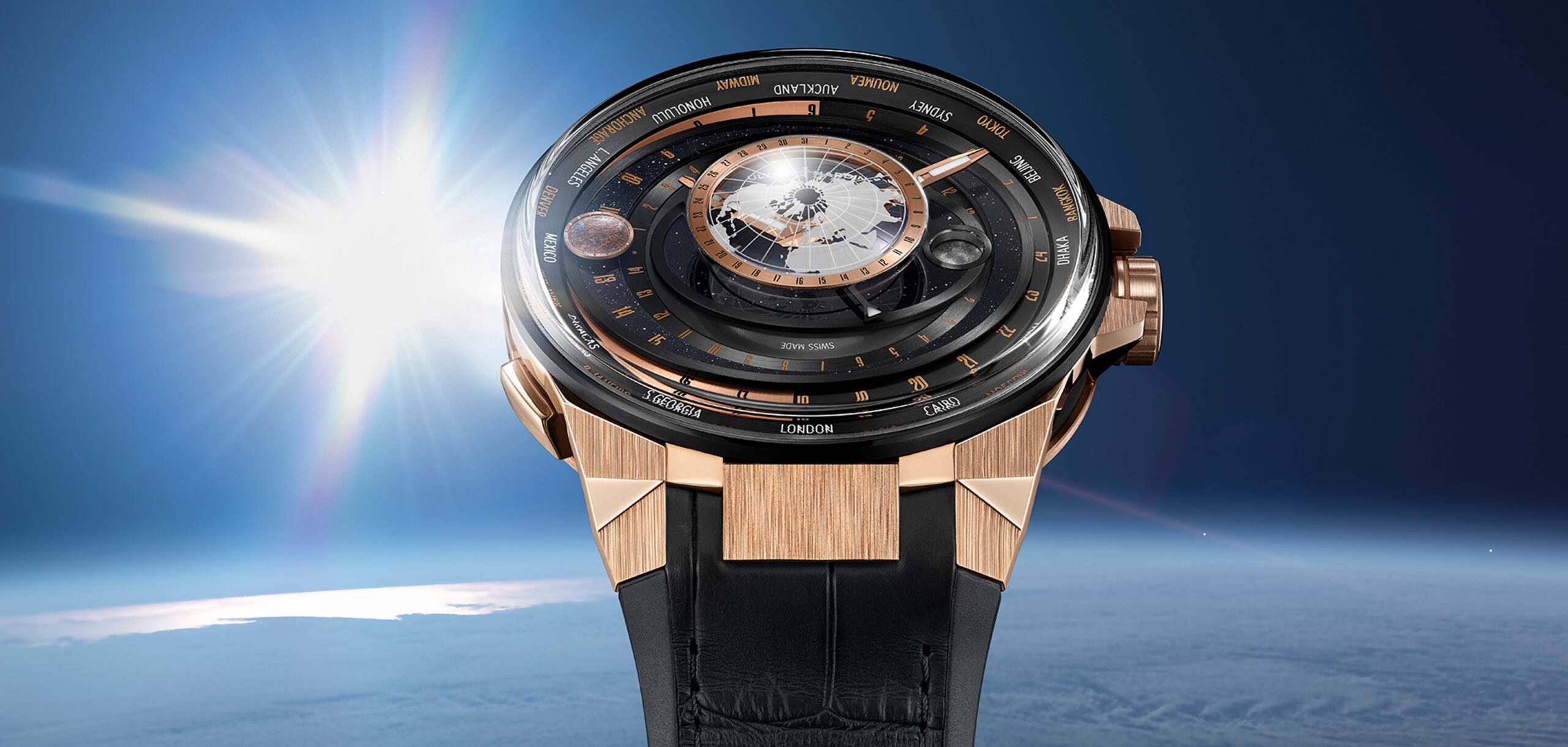
Ulysse Nardin: A Legacy of Astronomical Watchmaking


Ulysse Nardin has always treated watchmaking as an act of exploration. Since 1846, the Manufacture has pushed beyond conventional limits, guided by a belief that innovation emerges only when one dares to challenge what is considered possible. This philosophy shaped its earliest moonphase instruments and scientific timekeepers, and it later ignited a revolution in astronomical horology—one sparked in 1983, when Rolf Schnyder encountered the young Dr. Ludwig Oechslin and his extraordinary astronomical clock. As the document notes, Schnyder was “fascinated by both the complexity of the mechanism and the intellect behind it,” a fascination that led to a challenge: create a celestial instrument for the wrist.
Oechslin’s response became the Astrolabium Galileo Galilei, unveiled in 1985 and recognised as the world’s first astronomical wristwatch. It was followed by the Planetarium Copernicus and the Tellurium Johannes Kepler, forming the iconic Trilogy of Time—three pieces that transformed celestial mathematics into intuitive mechanical poetry. Decades later, Oechslin returned to this universe with the Moonstruck, a new interpretation of astronomical display that united the Earth, Sun and Moon within a single visual system.
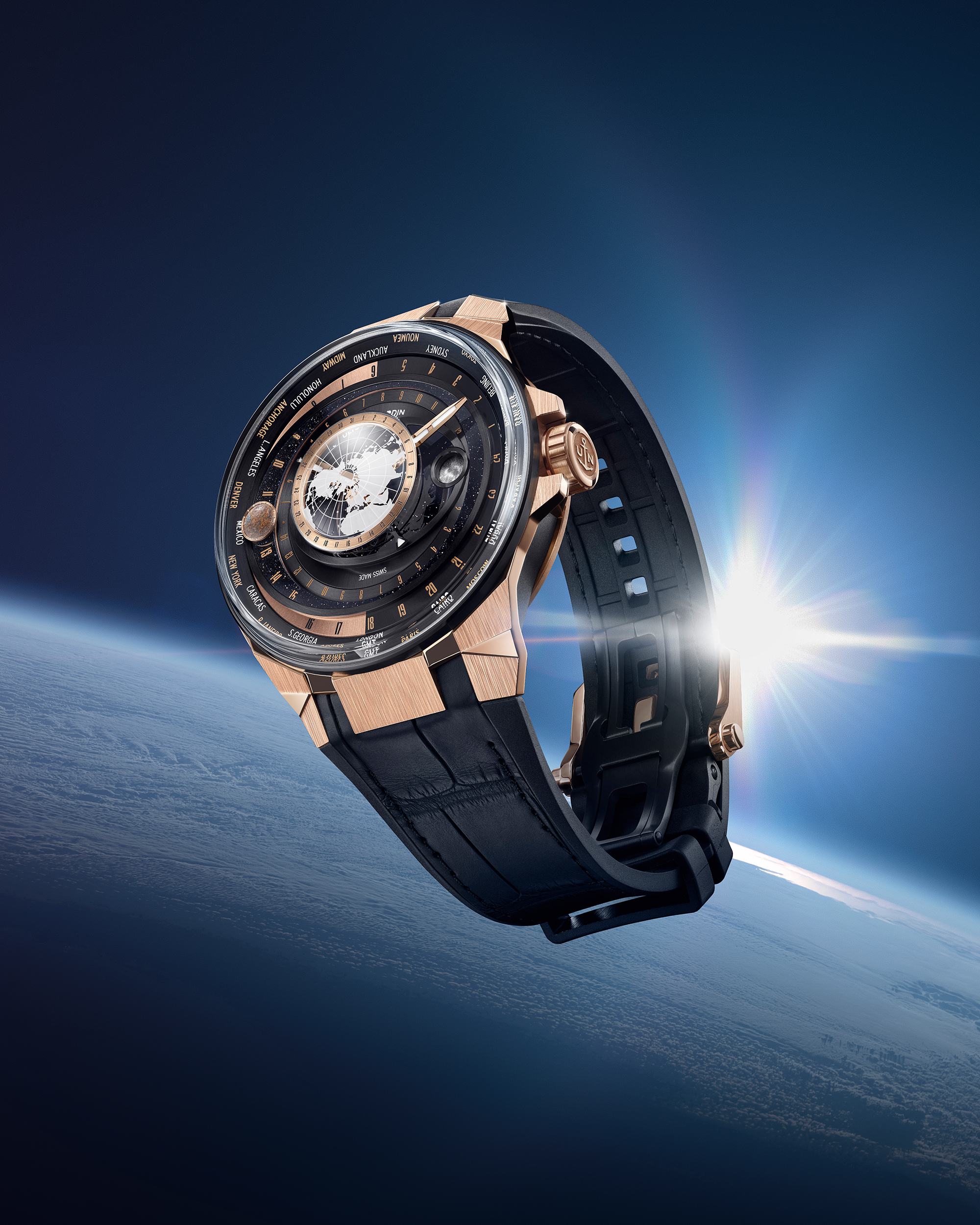
The latest chapter in this lineage is the Blast Moonstruck in rose gold, produced in just 20 pieces. It is one of the most technically ambitious creations in the Manufacture’s history, conceived in the spirit of Oechslin’s philosophy: complexity belongs inside the movement, never in the act of reading the watch.
A Unified Celestial Display
Rather than presenting isolated complications, the Blast Moonstruck integrates five astronomical indications into one coherent geocentric tableau. The document emphasises this principle clearly: “The apparent motion of the Sun, the real-time orbit of the Moon, the moonphase, lunar month and tidal coefficients are not displayed as separate complications, but as interconnected elements of a single astronomical model.”
At the centre sits a three-dimensional Northern Hemisphere, engraved beneath a domed sapphire structure and viewed from the North Pole. Around it, the Sun and Moon trace their paths in real time. The Sun is positioned on a rotating 24-hour worldtimer disc, allowing the wearer to read global time instantly while observing the Sun’s apparent movement across the Earth. A two-tone day/night ring enhances legibility and reinforces the geocentric perspective.
The Moon follows its own orbit, displaying both the lunar month and a moonphase accurate to a deviation of only one day every 40.3 years. True to Oechslin’s astronomical rigor, the illuminated portion of the Moon always faces the Sun—replicating natural celestial geometry rather than relying on a traditional moonphase aperture.
The interplay between Sun and Moon also drives the tidal coefficient indication, enabling the wearer to anticipate spring and neap tides. This nod to marine navigation echoes Ulysse Nardin’s historic role as a supplier of precision chronometers to navies and scientific expeditions.
The UN-106: A Movement Built for Celestial Precision
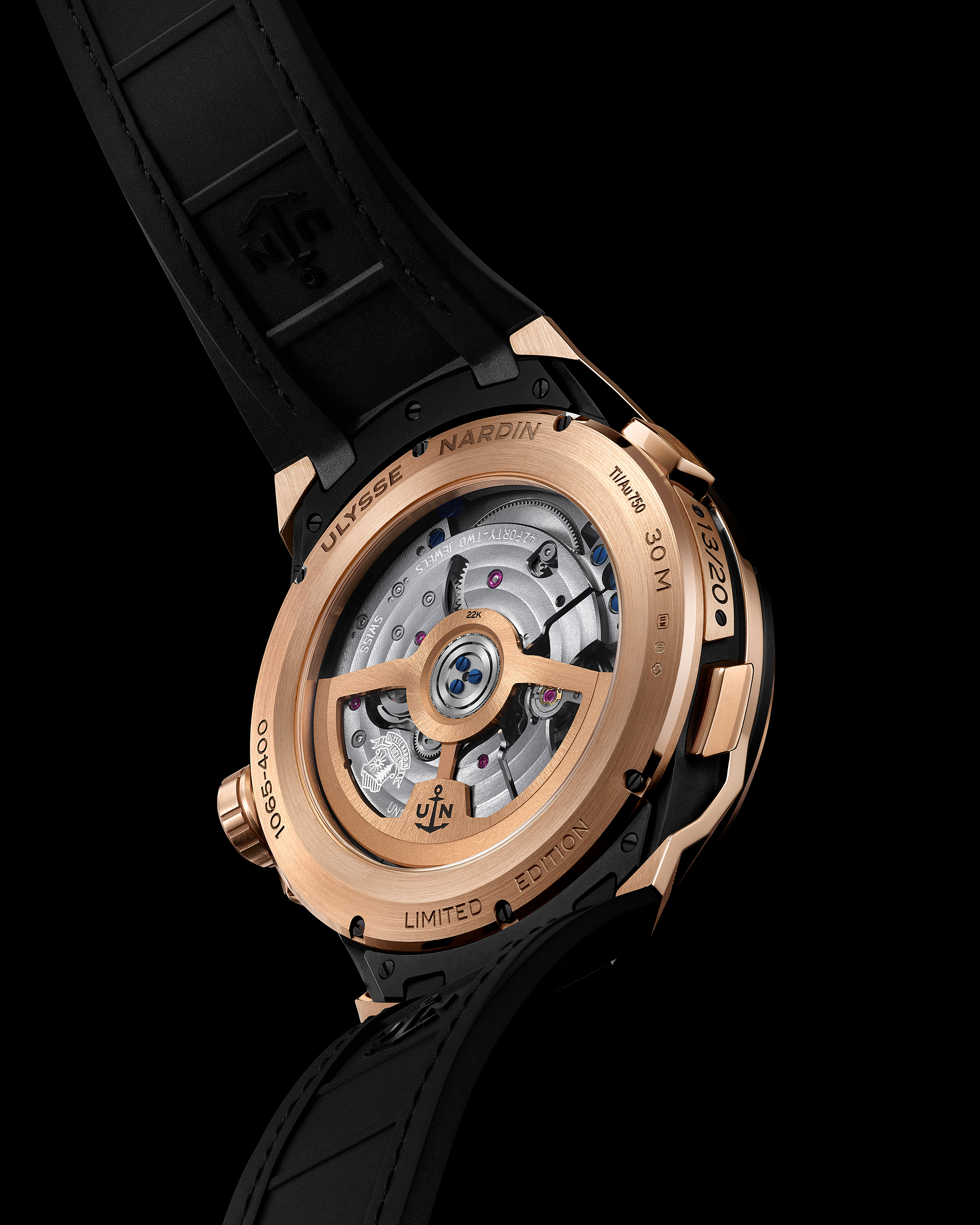
Inside the Blast Moonstruck beats the manufacture calibre UN‑106, an automatic movement composed of 338 components and 42 jewels. It integrates all astronomical indications and the worldtimer within a single mechanical architecture. Silicon technology—pioneered by Ulysse Nardin and first introduced with the Freak—plays a central role. The escapement and hairspring are crafted from silicon, ensuring anti-magnetic stability, reduced wear, and long-term precision.
The patented time-setting mechanism allows the wearer to adjust local time forwards or backwards in one-hour increments without disturbing the astronomical indications or the minute hand. Astronomical settings are controlled directly through the crown, supported by digital instructions that simplify the process.
Operating at 4 Hz and offering a 50-hour power reserve, the UN‑106 balances high horology complexity with everyday practicality.
Architectural Watchmaking in the Blast Collection
The Blast Moonstruck’s case architecture amplifies the three-dimensional nature of its celestial display. The 45 mm construction combines an 18 ct rose gold upper case with a black DLC-treated titanium middle and bezel. Satin and polished surfaces interact with laser-finished facets, creating a dynamic play of light that underscores the watch’s sculptural identity.
The sapphire glass box is engineered specifically for the Moonstruck’s geocentric layout. Beneath it, the suspended Northern Hemisphere appears to float above an aventurine dial whose shimmering texture evokes a star-filled sky. A rose gold ring engraved with the days of the month frames the display, adding depth and reinforcing the watch’s layered architecture.
Limited to 20 pieces, the Blast Moonstruck merges celestial mechanics, advanced materials, and contemporary design into one of Ulysse Nardin’s most ambitious astronomical creations.
A Legacy of Innovation
For 180 years, Ulysse Nardin has shaped the landscape of high horology—from marine chronometers to groundbreaking complications. From the moment the Manufacture introduced “the first perpetual calendar that could be set both forwards and backwards via the crown,” to the Freak, the brand revolutionised modern watchmaking with its use of silicon. Today, as part of an independent collective alongside Girard-Perregaux, Ulysse Nardin continues to redefine expectations for a heritage brand. The Blast Moonstruck stands as a testament to this spirit: a contemporary astronomical instrument that honours Oechslin’s vision while embracing the technological mastery that defines the Maison.
Share this article



LEAVE A COMMENT
You must be logged in to post a comment.