
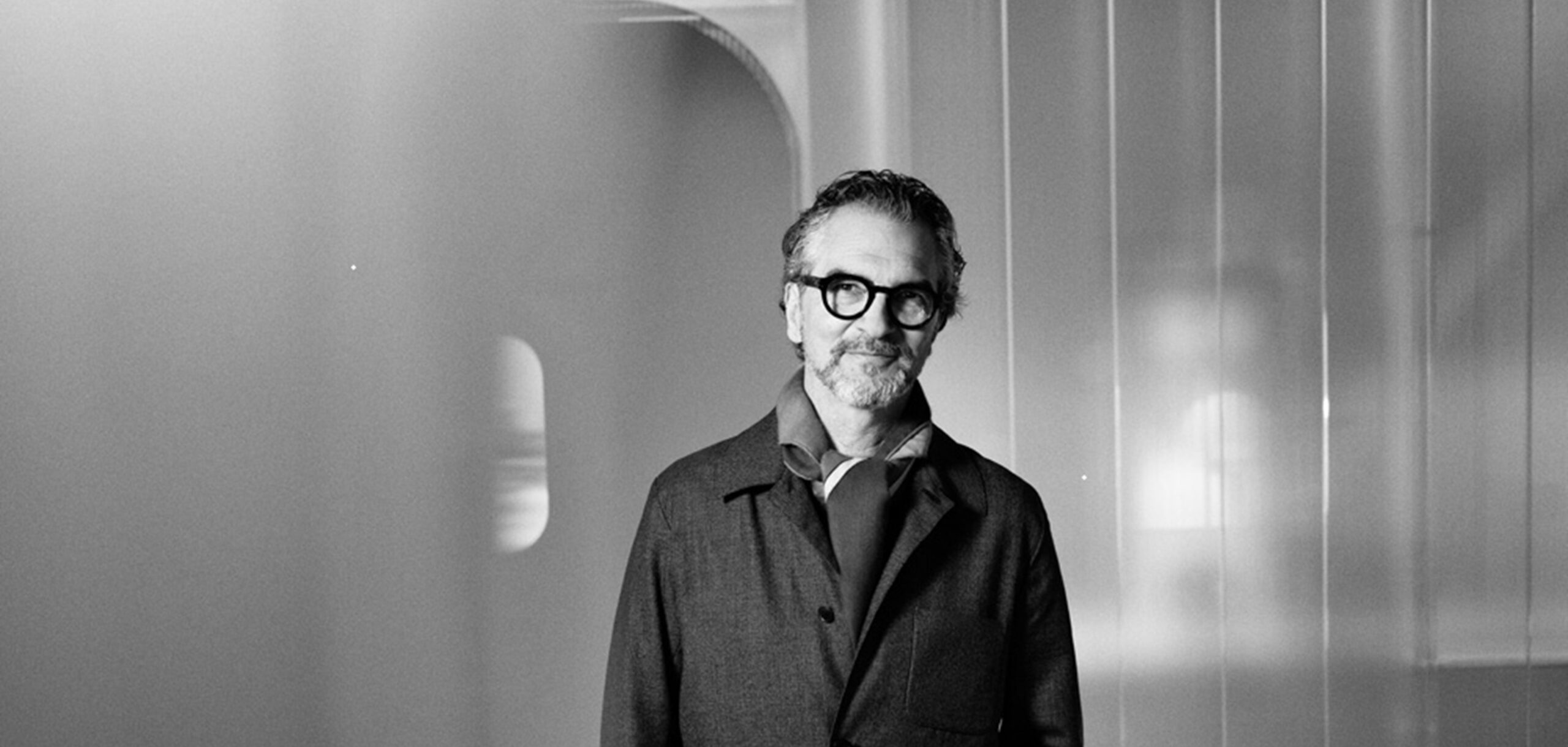
Philippe Delhotal: ”Shape is our vocabulary”


Although I felt I knew him already through his beautiful, original, innovative, whimsical creations, I was still a bit nervous and very happy to finally talk to him. What follows is a foray into one of the most creative minds of the 21st century, for which I am very grateful.
Raluca Michailov: Monsieur Delhotal, over the past 17 years you have been building the universe of Hermès watches up to the pinnacle on which it rests today. Can we go back to the beginning? When you were asked to come to Hermès to start your wonderful journey in watches, what was the first thought that came into your mind?
Philippe Delhotal: When I left my former employer to join Hermès, I was leaving what you might call the world of watchmaking, since my career has mainly revolved around that. I was entering a world that was a little… new. Because Hermès doesn’t just make watches – it’s a company with 16 different métiers, with a wealth of expertise, and it’s a world I didn’t know. So, obviously, watchmaking wasn’t a problem for me, however I had to discover other universes. Of course, I had heard about leather; I was still somewhat interested in it, but not in any detail. And when it came time to make this choice, it wasn’t easy, because obviously, when you leave a major watchmaker to join another company, it was a true challenge. I asked myself a lot of questions. What interested me most was the fact that I had access to a level of creativity that I wouldn’t have had at other companies, simply because the world of Hermès, with all its different crafts, is completely different from that of a traditional watchmaker. And that’s what really interested me, because I thought that in terms of creation, I would be entering a whole new world, and I would obviously be working with other crafts, other people, other skills, other creations. And that’s why I decided to make the change. And I don’t regret it at all. Absolutely not.
And, as you well know, the world of watchmaking can be really complex and closed off – how were the first steps for Hermès into that world, and how did you manage to convince everyone that Hermès was here to stay and to innovate?
You’re right, it’s a fairly closed-off world, dominated by a number of large, very traditional companies with a wealth of expertise and stories that are each as fascinating as the next. At Hermès, we didn’t have that history. So we had to create it, build up our legitimacy, and ask ourselves, ‘How are we going to be recognised in this very exclusive world of watchmaking? The goal was not to make watches, because others do that perfectly well, but to be different. And we had to bring that singularity to watchmaking. And that difference came precisely from finding, as I often say, that common thread, which started with ‘Le temps suspendu’ and then extended to other models, such as ‘L’heure masquée’, ‘L’heure impatiente’. You know, with all these great creations we’ve made, we brought singularity in watchmaking. We emphasised the story, not on complexity, because we weren’t necessarily looking to create overly elaborate complications, but above all we wanted to bring in a story, a style of writing that was unique to the maison. And I think that, looking at ourselves in the mirror, we’ve succeeded. And of course, we’re going to continue, we’ll bring other stories, other concepts, each as creative as the next. It’s true that the road hasn’t been easy, because we’ve had to be recognised by the profession, by journalists, by clients. And that was a difficult road.
And I can still remember the shock, really, the shock that I had when I first saw ‘Le temps suspendu’, which for me was proof that you can still innovate in this world. And I’m a big admirer of your work. And I wanted to ask you: it’s been almost 20 years, what are you most proud of in terms of watch design and innovation in your work?
It’s always difficult to choose. But you have to do it from time to time. If I had to name one watch that represents the difference in watchmaking at Hermès, it would be ‘Le temps suspendu’.
Yes, I completely agree.
Yes, because it was the first watch that really talked about time in a different way. And I really liked this nod to the stopping of time. Obviously, in watchmaking, you can’t stop time. A watch that doesn’t work is ultimately useless. And watchmakers are there more to count the seconds one after the other than to stop time. And then, in the stopping of time, there is also a notion, a notion that is very personal to us, namely that of using time to do things well. And it’s truly a beautiful signature, both for watchmaking and for the brand. Because when we talk about time at Hermès, we’re talking about the time of artisans, the time of creation, the time of craftsmanship, and sometimes the time to pause and reflect before moving forward. Why not? And I think this watch provides a very beautiful explanation of that. And I think it represents the DNA of our maison quite well.
I would like to speak a bit about shapes, because the shapes at Hermès, they are fascinating, in my opinion. And I wanted to ask you: what’s the message that you’re sending out with these very out-of-the-box and innovative shape designs that you create?
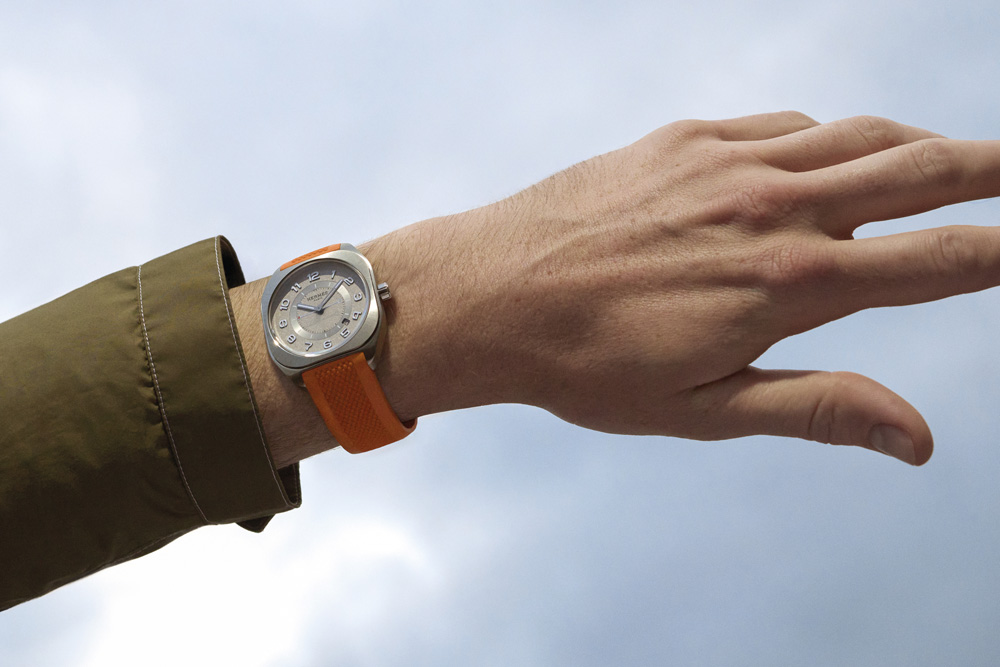
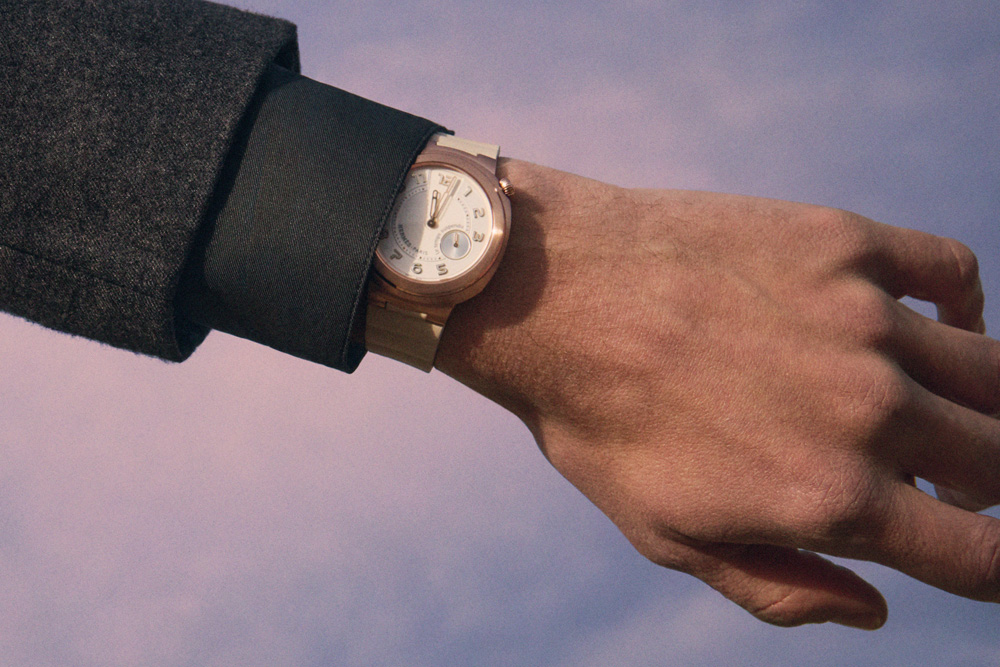
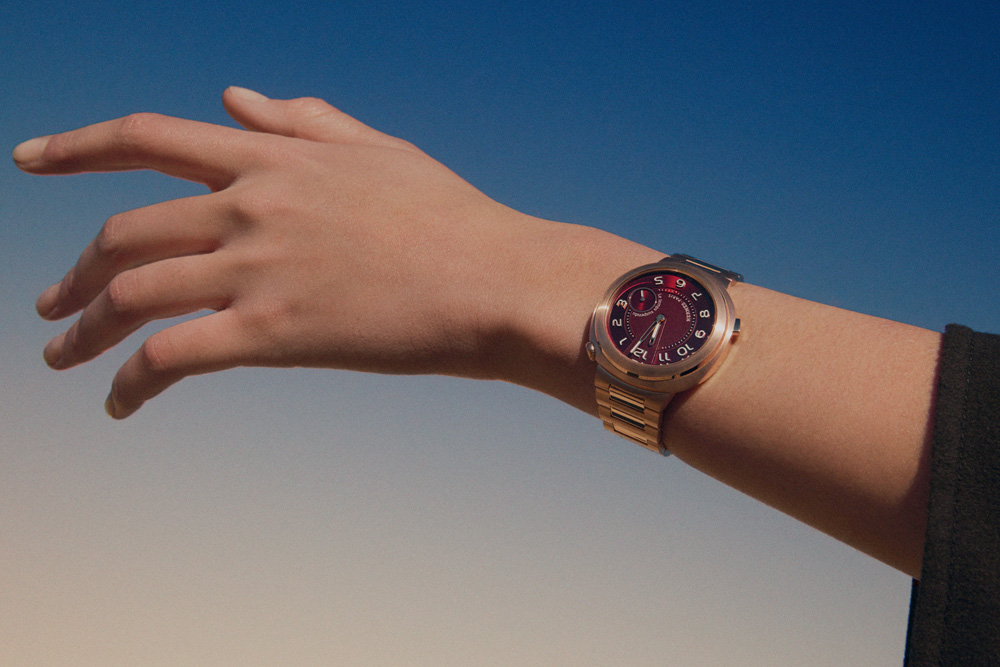
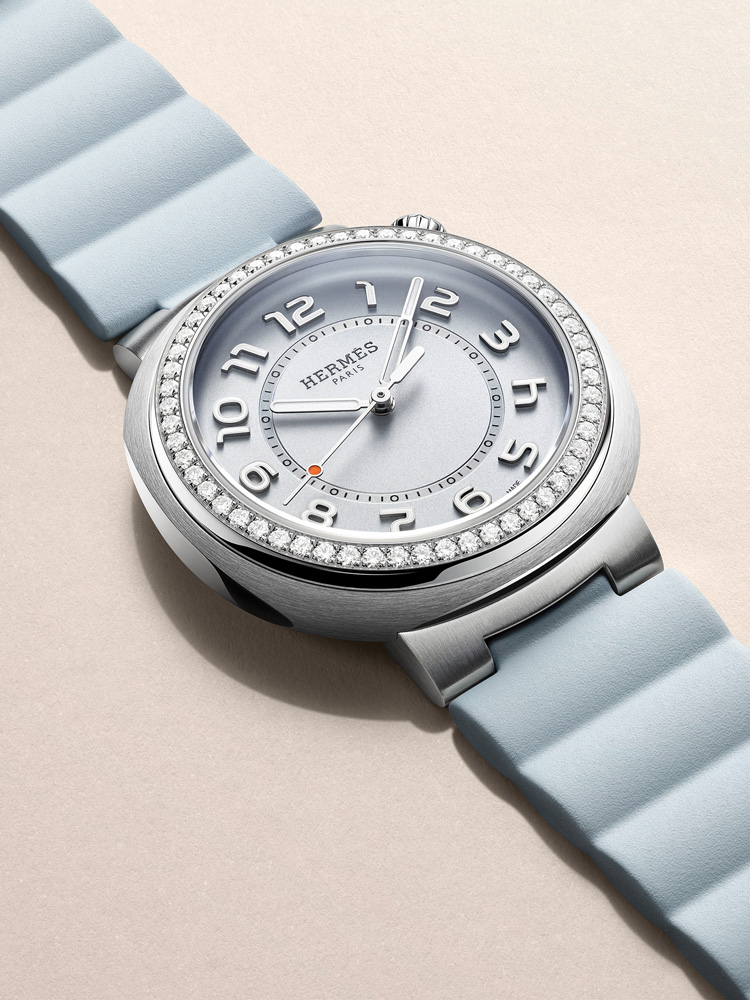
Shape is the vocabulary of the Maison. I’m not necessarily talking about watchmaking, but all our objects have distinctive shapes: shapes that have been crafted, shapes that have fallen from the sky. There is always a story behind a shape, whether it’s an object in the house or a watch, for example. If I take the watch, it has a rich history. If you take the watch, it also has a rich history. The Hermès H08 is unique; it is a contemporary, urban watch for men. So there is always a connection that reminds us of something and that we hold on to. It’s not about designing something that doesn’t tell a story. At Hermès, we are like storytellers, whether in our squares or in the shapes of our objects. And of course, this is reflected in watchmaking. If you look at all our watches, it’s true that we have a multitude of shapes. Take models such as ‘Heure H’, ‘Cape Cod’, ‘Arceau’, ‘Galop d’Hermès’, ‘Hermès H08’. With the exception of the Slim d’Hermès, which is a very classic round shape, all our objects, all our watches, are a universe of shapes. And that’s really a signature of the company compared to certain competitors. We always have this distinctive feature of offering and creating universes of shapes, which isn’t necessarily the easiest thing to do.
That is true. There are three things that I really, really love about your work. One is the shape. The other one is the difference, the innovation. And the third is a sense of humour. How important is a little sense of humour for you in your work?
We talk about humour, difference, grains of sand, and all these aspects make our objects unique. When we talk about humour, it is obviously part of our history. For example, if you have the chance to visit the Émile Hermès Museum, you will see that there is a lot of humour in the objects, in their stories. Humour is part of our everyday life. We always say that we act with lightness, with humour, but also with seriousness. And this is reflected in our objects. The latest one you know about is the ‘Rocabar de Rire’, by Dimitri Rybaltchenko. When we saw that drawing, we thought we had to do something with it on a watch, and that’s what led us to add this mechanical animation to this watch. When you press the little button, the horse’s tongue pops out. It’s part of the brand’s sense of humour. I think it’s important, in a complex world, to add a touch of humour to our objects; it transports us, lets us breathe, and makes us dream. This will always be present in objects – not just watches, but objects in general.
In general, yes. And also, regarding innovation: because you were speaking about this somewhat difficult time, and so many people are saying that there is nothing left to innovate and to discover, but you are proving the contrary with everything you are doing… Do you think there are still big discoveries and innovations to be made in watchmaking, and in design?
You know, innovation is a big word. Everyone wants to innovate, whether in terms of materials or technical solutions. Innovation is everywhere. It doesn’t necessarily boil down to excellent equipment that we’ll be releasing in ten years’ time. It can lie in a particular concept. If I take the example of ‘Le temps suspendu’, there was a certain form of innovation in the act of stopping time. For me, that’s also an innovation. We’re not necessarily always looking for new materials. But you know that a lot of things have already been used. We always end up going round in circles with the same old things.
Yes, exactly.
If I take Hermès as an example, one form of innovation was the use of horsehair.
Yes, but that makes sense.
Yes, we wanted to incorporate that into our watch. What’s more, the mane is linked to the history of the company. It was a rather successful innovation. For example, when we used Saint-Louis crystal to make dials, that was also a form of innovation. Our mission, in all our businesses, is to find artisans who are also research partners, companies or firms specialising in innovation. We need to be everywhere; we need to be curious. Being curious, taking an interest in what nature has to offer, in our surroundings, in the spirit of the times, this is also part of our mission. We don’t just use inert materials. Innovation lies in creation, movement, clothing, colour. Innovation is everywhere.
You are right. Also speaking about innovation, many are relying now on AI. Do you see a future where AI can be your partner?
AI is now part of our lives. We need to be aware of that. There’s a lot of talk about it. Many people use it. Others don’t. I would say a little bit… that’s my answer. I feel, perhaps not on the same scale, but I feel that it’s a bit like smart watches. In other words, at one point, online worlds scared us. It scared the profession. What’s going to happen? Smart watches have arrived. We won’t have mechanical worlds anymore. What happened? Smart watches have lived their lives, their journey, with all the advantages they offer, which are more instruments than worlds. Traditional watchmakers, what did they do? They continued to innovate. They continued to create. Because they knew there was something fragile within them that they had to express and remain different. And I find that today, the two worlds, connected and traditional, coexist quite well. There is a kind of coexistence that happens naturally. Artificial intelligence can be useful, I think. Of course it can, because it’s based on algorithms that are incredibly powerful.
Yes, that’s true.
And I think it can be useful for some professions, perhaps less so for others. Personally, I’ve never used it in creative work, but I’m not saying I won’t use it one day. Why not? It can help us. I think we shouldn’t ignore what technology has to offer. But we need to use it with caution and intelligence. It’s a question of balance. But I believe much more in intelligence, not artificial intelligence, but the intelligence of the brain, the human brain. Much more. But we need to be curious and attentive.
Yes, but that’s a problem. Because many people are no longer curious or attentive.
We must not lose our soul or our creativity, nor should we favour ease, because artificial intelligence is also a notion of ease. This means that ease prevents us from searching, from struggling to find, from forcing ourselves to do things, and finally from always being alert and developing our brains. If tomorrow everything is done by artificial intelligence, humans will disappear. There will be no more reflection, all of that will disappear. That is why we must be very careful. But we must be attentive, because I think that artificial intelligence can provide answers to certain current problems.
Yes, that’s true. And just out of curiosity, if you hadn’t been born in the 20th century, when do you think you would have liked to have lived and created?
My answer is very simple: in 1950. Simply because, for me, it was the post-war period, and everything had to be rebuilt. Everything had to be rebuilt. It’s a period that fascinates me, because new materials were coming on the scene: aluminium, plastic, chipboard. A whole range of materials had just arrived, because after the war, everything had disappeared, and everything had to be rebuilt. And that’s why I really like that period, because we did incredible things, we made furniture, there were colours, bright colours, because people needed that too. People needed to be given hope again. I would have liked to have lived through those years. There are other periods that I find interesting, but that one particularly, in terms of creativity.
So, if AI invents time travel, you would like to go back to the 1950s?
Yes.
And just one more question, what comes next for you?
I’m going to talk about the watchmaking profession. I think we’re going to continue along the path we’ve opened up with this particular era. Being able to talk about it differently and translate it differently onto our watches. To develop creativity, work on other subjects. For example, watchmaking objects. We’ve done very little work on objects. Remember, we made that magnificent clock in collaboration with a large watch manufacturer. We have also made many objects in the past, and we would like to return to objects – alarm clocks, all these nomadic objects that can be used in watchmaking. Developing crafts, curiosity, finding new techniques and new skills. It is also interesting to be able to develop this. So there is a whole creative environment to develop, to continue along the path we have taken. And I think there is still a lot to be done. You know, when people say that everything has already been invented, that’s not true. Just look at the watchmaking profession, the Grand Prix d’Horlogerie. There is still a lot of inventiveness and creativity going on. I think watchmakers are fantastic; they come up with new things every year. I admire this profession. Personally, I would like to tell you this: I have worked extensively in watchmaking throughout my career. I intend to continue, but I won’t be able to keep going for another ten years, because my age will tell me that I have to stop and hand over the reins to someone else. And I am proud of that.
But if you still have enthusiasm and creativity, this is not the time to stop. Age has nothing to do with it.
No, but I’m going to stop at some point, because I’ve always had this creative enthusiasm and it will always remain with me. One day, I may have to do something else that I haven’t been able to do thus far. As a person, I’ve always been passionate about watchmaking, and I will continue to follow its story with enthusiasm.
Thank you very much.
Share this article
LEAVE A COMMENT
You must be logged in to post a comment.