


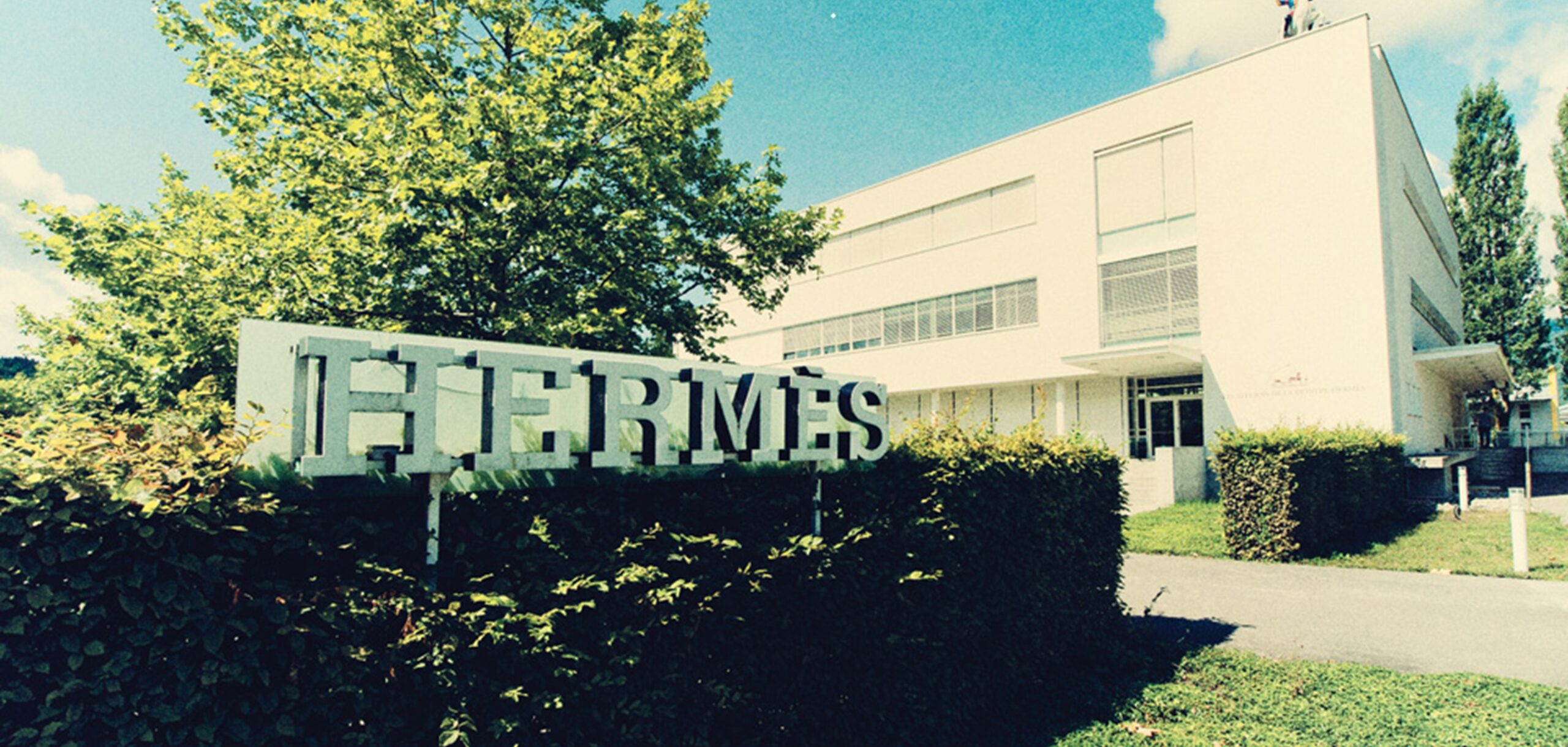
Hermès: The human touch


However, I like to think that I am also open-minded and always ready and willing to learn new things and, if the evidence points that way, even change my mind.
So I took the time to take a really good look at Hermès. To really understand where they were coming from, how the watches were born, what the long-term vision was. And I discovered a brand that was unique and quirky, French but also universal, cool but also philosophical. And, most of all, I discovered a true watch brand that has been genuinely committed to making ‘real’ watches for a very long time.
Then I had the pleasure of a discussion with the Hermès Horloger CEO, M. Laurent Dordet, who proved such a wise, thoughtful, cultivated watch specialist, thinker and visionary, that I really did fall in love with the brand.
This August brought our visit to the Hermès Horloger manufactures in Le Noirmont and Brügg, as part of our traditional yearly ManufacTOUR. The visit was impeccably organised by the Hermès Horloger team, who made sure that we saw anything and everything of interest, culminating with a reinvigorating and exhilarating talk with the renowned Philippe Delhotal, the Creation Director of Hermès Horloger (you can read the interview in the following pages).
Hermès has an impressive production site in Le Noirmont, while Brügg is home to watch assembly and the famed leather atelier – a place where I could happily spend entire days just watching the amazing ladies create the watch straps and some of the most spectacular dials I have ever seen.
The Maison will have a big year in 2028, marking a century since it made its first serious foray into watchmaking with the release of the Ermeto watch, as well as 50 years since the birth of La Montre Hermès in Bienne (Switzerland, of course). Another significant move occurred in 2006, when the company acquired a 25% stake in Vaucher, a highly respected movement maker.
Hermès then acquired dial manufacturer Natéber in 2012, and Swiss case maker Joseph Erard in 2013, with a view to creating a complete and independent manufacture for its watches. In 2017, Les Ateliers d’Hermès Horloger appeared in Le Noirmont, which signalled the brand’s deep commitment to its horological dimension, combining its unrivalled luxury know-how with French flair and a very serious-minded Swiss approach.
Le Noirmont
I have so far been blessed to visit many watch manufacturing facilities, ranging from fully automated to mostly artisanal.
The thing I liked the most about the Hermès manufacture in Le Noirmont was the very harmonious blend between the human touch and machine precision. I loved the fact that the brand is very invested in maintaining human ‘supremacy’, which I strongly feel will be a very important – if not the only – differentiating factor in the not-so-distant future, which will probably see many sectors bow down to AI.
Every story in the watch dial atelier in Le Noirmont begins with brass, which is used as the base material for around 95% of the Hermès dials. The rest is generally worked in gold. Moreover, the Maison also uses recycled steel and brass in many cases, working towards increased sustainability.
Stamping is one of the main activities in Le Noirmont, as the primary shape is obtained from a solid sheet of brass. I loved the fact that all the tools needed to do the stamping for all the timepieces are produced by Hermès. Shape, as I know well, is highly important for Hermès, so the team creates all the necessary tooling for all the shapes in the collection. Sadly, this ‘tooling to create the tooling’ is a craft that is disappearing, but Hermès works hard at keeping it alive”, solutions to keep this craftsmanship internally and for the next generations. Then, soldering operations begin – the minuscule feet attached to the dial are paramount for stability and alignment and for the subsequent decorative and technical operations.
The dials are, in fact, subjected to many treatments and operations during their manufacturing journey: CNC machining, polishing, electroplating – all very technical undertakings, but, at the same time, always under human supervision and control, as the human mind, eye and hand reign supreme at Hermès.
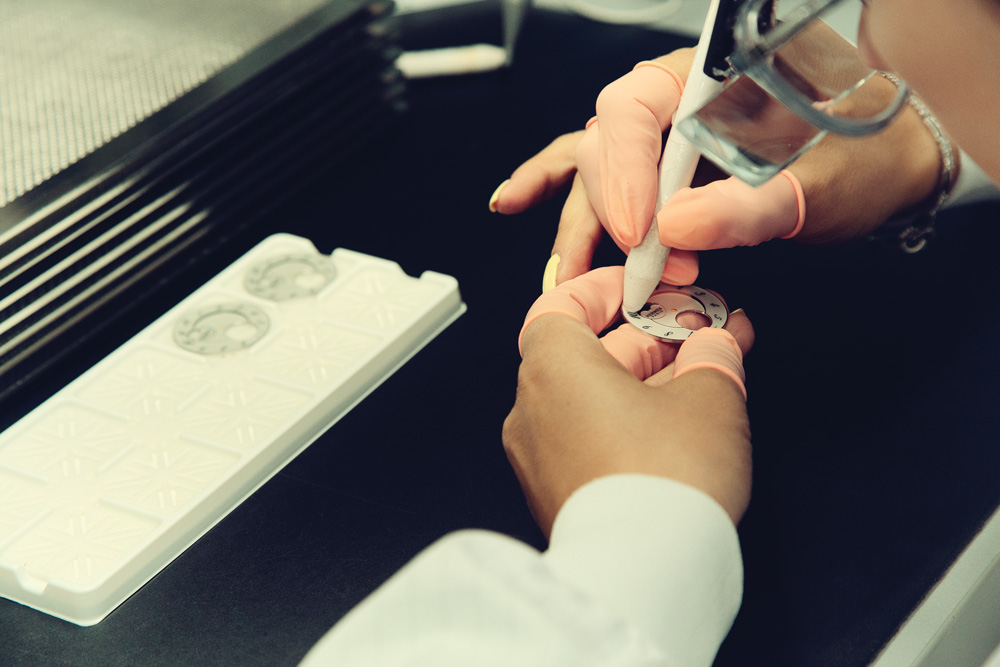
Before a dial can officially be called a dial, it needs to undergo smoothing treatments for its uneven surface, which poses the problem of attaining the exact thickness required. Also, at this point in the dial production process, the accuracy of its dimensions is determined by the human eye, with the help of a measuring device.
As an outsider, as I stood behind the straight backs and quick working hands of the watch artisans, smoothing and polishing looked so easy and effortless that I was tempted to give it a go, until I realised the enormity of talent and experience needed to obtain the perfect surface in just a few minutes.
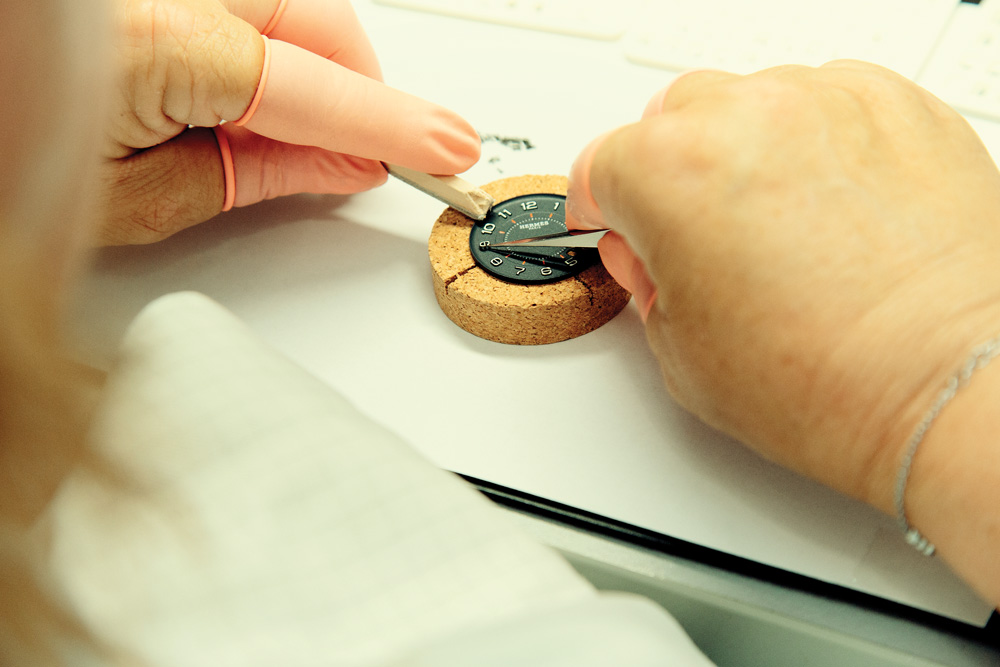
Lacquering is one of my favourite parts of the process of bringing the dial to life, and I have to say I much prefer it when it is done by the human hand. And so is polishing, which sounds like something car-related to the untrained ear, but which is crucial in the birth of a watch.
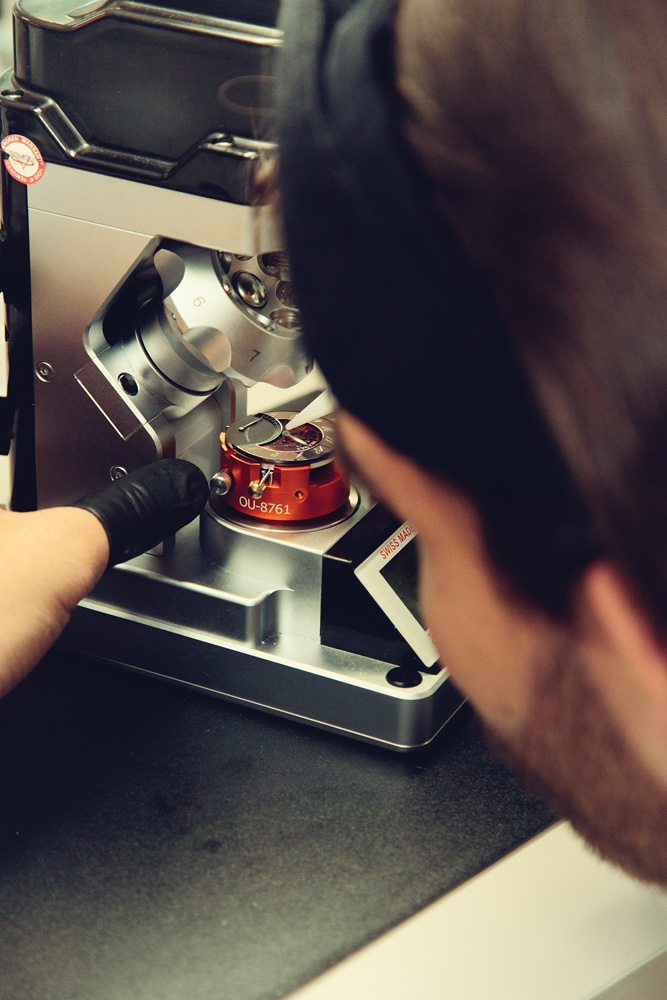
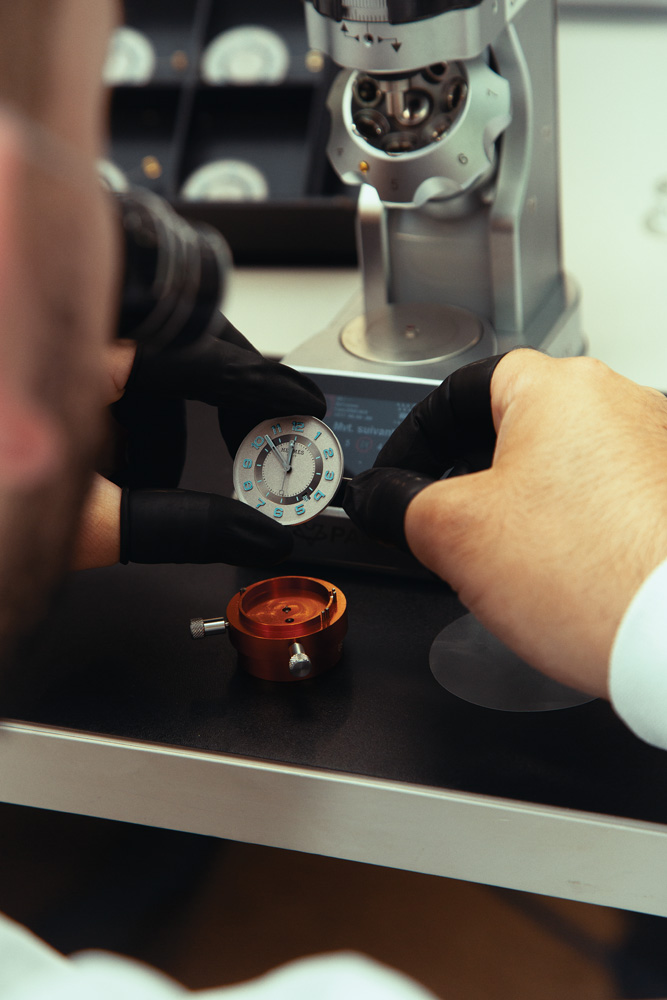
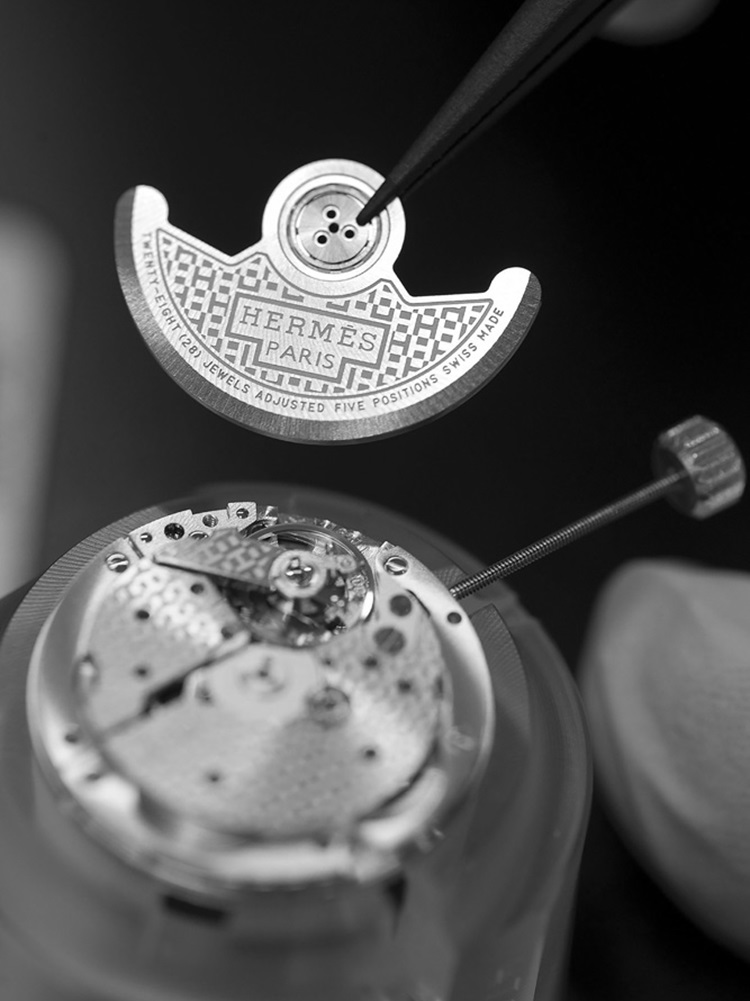

Electroplating (applying a metallic coating to surfaces using an electric current) is also a very important part of the manufacturing process at Hermès. I stood in awe before the artisan demonstrating the actual emergence of the famous blue finish – the way they just know exactly how many seconds or minutes they need in order to come up with that incredibly deep blue shade that Hermès is known for. This is called ‘la mise en couleur’, and it is very challenging, because the colour is considered a success only if the human eye and experience are perfectly satisfied. The workshop uses recycled water systems to improve the sustainability of its operations.
As I have long noted, everything technical sounds better in French: brossage (brushing), ébavurage (removing excess material and cleaning), visitage (final quality control – only human eyes, and only ladies’!). And then there is adoucissage, another poetic-sounding French word, which means softening before and after lacquering, and which is done by hand. For the lacquer polishing, which is also done manually, solely the human eye and hand can guarantee the thickness.
Each and every piece goes back and forth several times, and there are a lot of interactions. As the saying goes, ‘it takes a village’ to make sure that every timepiece that is ‘born’ here is perfect by the time it leaves home.
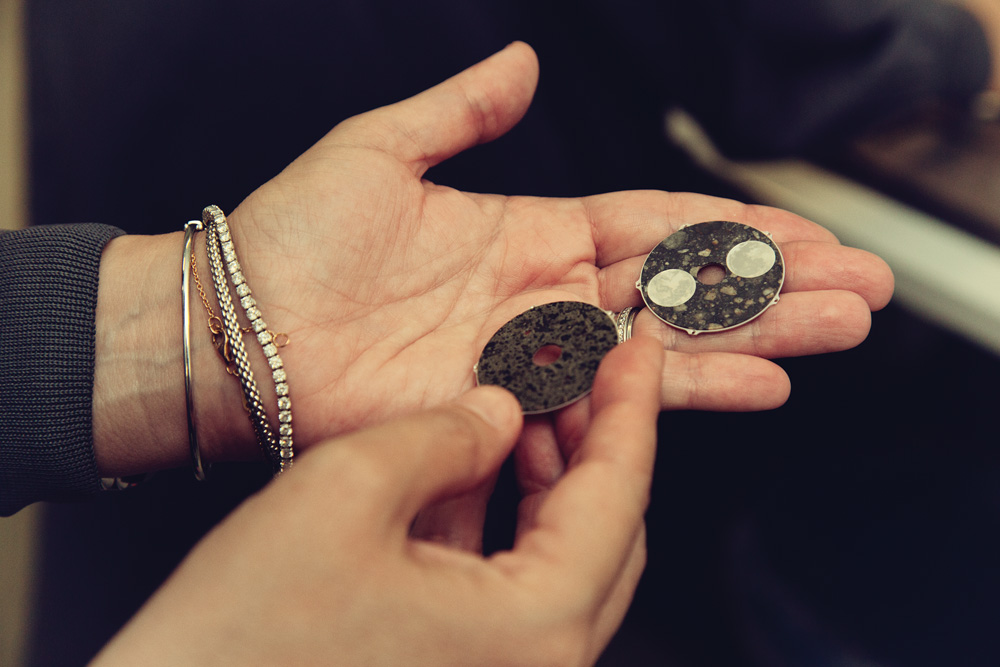
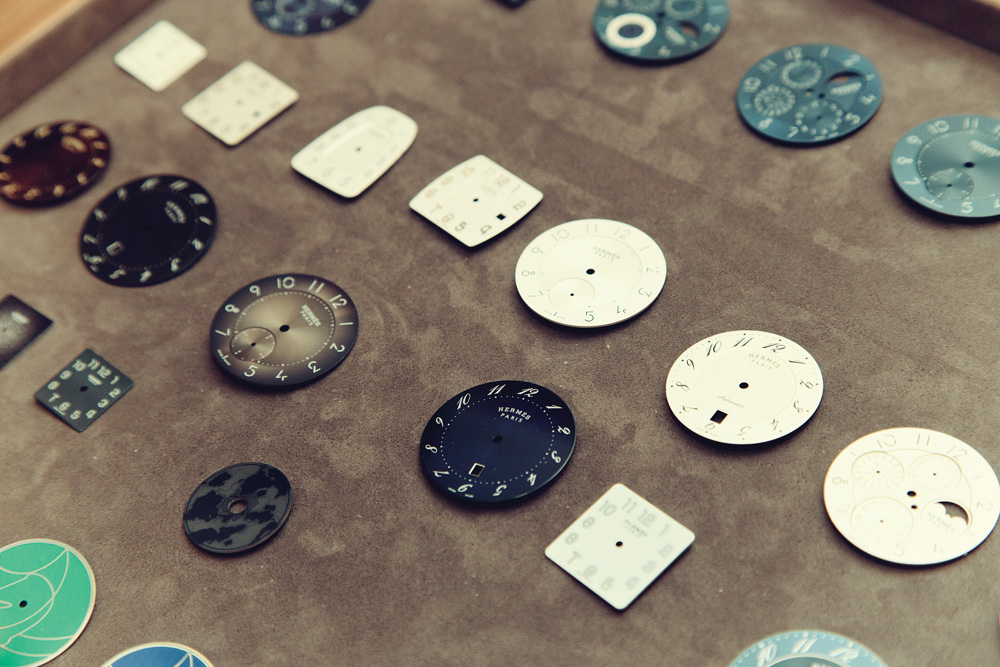
Hermès creates a lot of subtle, restrained dials, which work well in any context, but also very spectacular pieces – from aventurine, jade, meteorite, mother-of-pearl and other rare and very delicate materials. So each dial is different and unique in some way, and requires enormous attention and imagination. I love how Hermès watches are understated and spectacular at the same time – like a French garden, in a way.
The Maison is also famous for its original case shapes, so production is quite complex, requiring up to 20 steps.
First, the parts are cut and stamped by machines overseen by the engineers. The parts are cleaned and then sent to a kiln, where all the pieces go to be ‘cooked’ (1080 degrees for steel and 700 degrees Celsius for gold), then more stamping, followed by polishing for that flawless finish.
The pre-polishing is done by machine, when possible, but at least they are old-school machines. I also love the fact that each artisan assembles their own brushes and utensils, choosing their preferred types of cotton and fabric for polishing and buffing.
Polishing requires attention, precision, creativity, tact, efficiency, accuracy and talent. The dial needs to look smooth and perfect, which is even more difficult when it comes to darker colours as they tend to show up all the flaws, even if they are practically microscopic.
Brügg
The very highly skilled watchmakers and artisans in Brügg are responsible for the beginning-to-end assembly of timepieces. I must confess that, after the very intense manufacturing activity in Le Noirmont, I was very happy to bathe in the light, peace and quiet of the Brügg ateliers, where the relaxed artisans give life to perfect timepieces by assembling them from the first component to the last. I most envied the specialists that were entrusted with the high complications, because Hermès is, in my opinion, one of the very top watchmakers in terms of complicated watches: complexity, innovation, originality, humour: everything is there, and it is incomparable. The Hermès H08 and Hermès Arceau Le temps voyageur are among my favourite models from Hermès, so I spent some quality moments witnessing their birth.
Again, everything is sunny there: the rooms and the mood, as all the watchmakers love their work and it shows in the assembled, finished timepieces.
At the end comes strap fastening. Sometimes I think that straps are my favourite part of an Hermès watch, which is of course a very superficial thing to say – however, Hermès straps are small masterpieces in themselves, so I hope I may be forgiven for being somewhat obsessed with them.
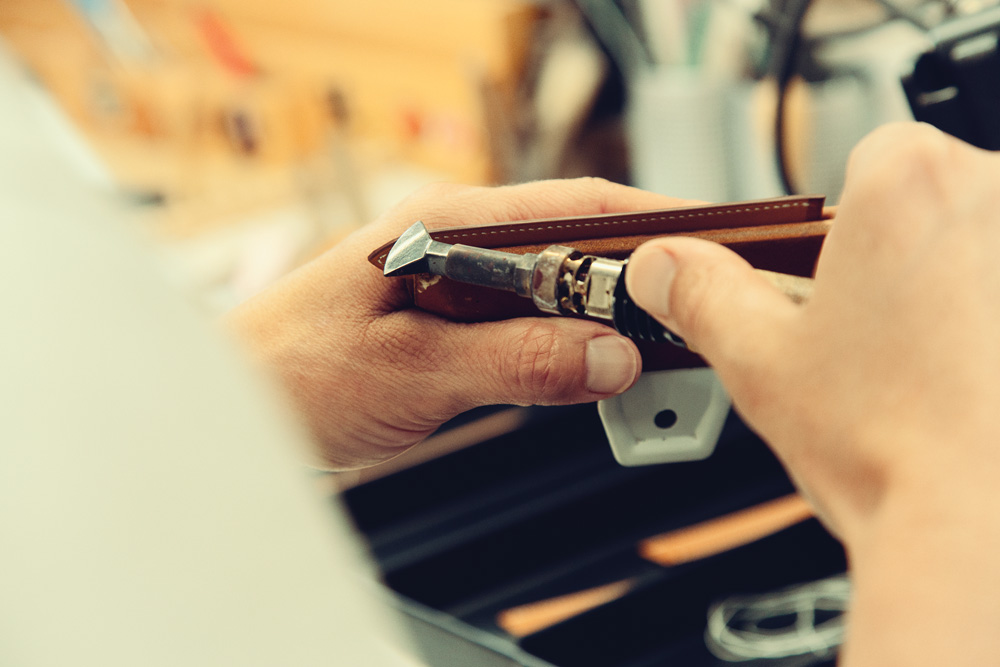
So it does not come as a surprise that my moment of absolute joy was the time I was given in the leather strap workshop. All, absolutely all of the ladies there exude warmth, camaraderie and a genius for coaxing and cajoling leather into whatever special piece they can dream into being. And they do a lot of dreaming!
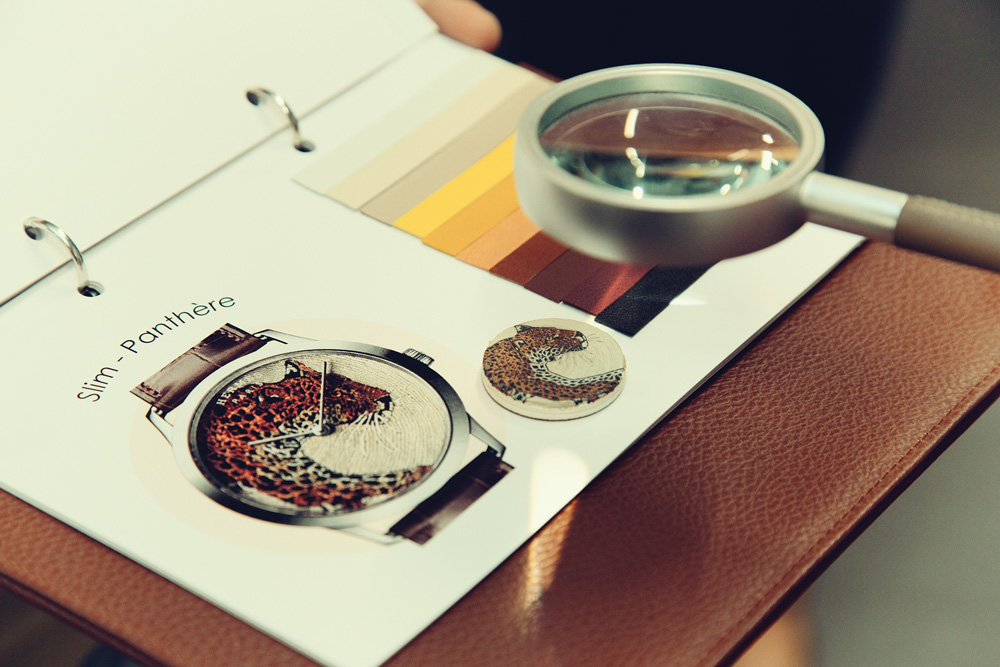
The straps are true works of art, necessitating a level of expertise and accuracy that I do think has no equal. Whether it’s splitting the leather, sewing the perfect stitches or the blind stitches, hammering, sanding, polishing, heating (which is like ‘ironing’ the corners): everything is done by hand by this squad of Hermès leather ladies and gentlemen. And that’s not all: I was super impressed by their stories, as well as with the images of all the leather marquetry and mosaic dials that they were creating in order to bring to life some of the most incredible watch creations I have ever seen, from horses to zebras, leopards and, yes, dinosaurs.
We had a very full day visiting Le Noirmont and Brügg with Hermès, but I left feeling hopeful. Hopeful that the human hand and heart still make a difference, THE difference. That métiers d’art will not die. That originality and tongue-in-cheek humour are not dead. And that all of the above are in the good, talented, firm hands of Hermès Horlogerie.


Share this article


LEAVE A COMMENT
You must be logged in to post a comment.