


Flying High


The story of the Chronomat officially began in 1941 (although some say it was 1942), but Breitling submitted a patent application for a watch with a slide rule in 1940.
The timepiece resembled the on-board instruments and its ingenious design made it possible to perform various mathematical calculations and measurements easily and quickly. For example, it allowed you to convert speed from miles to kilometres, calculate fuel consumption, convert distances into various units and perform operations such as multiplication and division.
Before the Chronomat appeared on the market, Breitling developed and then quickly patented a system that improved the functionality and reliability of onboard instruments. This was the company’s ticket into the world of aviation, first military (shortly before the outbreak of World War II, a representative of the British Ministry of Aviation ordered a large number of onboard chronographs for aircraft belonging to the Royal Air Force), and later civil aviation. Breitling timepieces became so well-known in the aviation industry that on-board chronographs produced in the early 1950s were already being used in the cockpits of more than 25 major airlines, including: United Airlines, BOAC, Lockheed, Douglas, KLM, Vickers and Air France.
The functionality and usefulness of the Chronomat as a miniature mechanical computer was appreciated not only by pilots, for whom it was designed, but also by engineers and technicians in various disciplines (in fact, since 1945, it has been advertised as a model for athletes, mathematicians and engineers). The watch was available in several versions with different cases and dials, but all of them had the same movement, i.e. the hand-wound calibre Venus 175 with a 45-minute counter at 3 o’clock and a small seconds counter at 9 o’clock.
In the centre of the dial there was a red scale from 0 to 100, which could be used to measure hundredths of a minute. Inside there was the inscription “Breitling Chronomat”, and below it a Swiss cross and the number 217012 – a reference to the Swiss patent obtained in 1940. As with most Breitling chronographs from that period, the minute counter had special indices for 3, 6 and 9 minutes. This was due to the tariffs for telephone calls in most countries. Long-distance calls were paid for in 3-minute increments, and each call was routed through an operator, so it was important to monitor the duration.
In 1942, a year after the first Chronomat was launched, Breitling introduced the Chronomat Moonphase with additional moon phase indications located at 12 o’clock. This timepiece was also powered by a Venus movement, which at that time was the most important supplier of movements for Breitling. The hand-wound calibre 184 was chosen for the Chronomat Moonphase, which, in addition to the moon phase indicator, also had a 12-hour chronograph counter and a hand date indicator.
The models created in the 1940s are currently considered by collectors to be among the most attractive watches ever produced by Breitling.
The stainless-steel versions were the most popular, but Breitling also produced versions with gold cases, which often had a more beautifully decorated Venus calibre 175, as evidenced by the “Premier” engraving.
Breitling’s management understood perfectly that a good product was not enough. Customers had to be convinced. That’s why, in the second half of the 1940s, Chronomat advertisements featured the famous American actor of Cuban origin Cesar Romero, who was then associated with 20th Century Fox and starred in the 1947 film “Captain from Castile”.
The success of the Chronomat contributed to the creation of the more refined Navitimer in 1952 – a model that became an even greater legend among pilots.

Cosmetic Changes and a New Movement
During the 1950s and into the mid-1960s, the Chronomat underwent minor modifications. First, the Arabic numerals were replaced with apllied indexes with a double index at 12 o’clock. Later, a version with a gold crown, hands, and indices was introduced, as well as a version in a gold case with a dial and hands that were covered with luminous material. The movement remained the same, so the changes were purely cosmetic. In the late 1950s, the dial was redesigned: the Swiss cross and the patent number disappeared (they were moved on the caseback), the crown was larger, and the chronograph buttons were round instead of rectangular. Around 1962, the dial was slightly modified again: for example, an arrow appeared at 12 o’clock, a reference to aviation (at the time, Breitling had bought an advertisement in a magazine published by AOPA, presenting a new version of the Chronomat, which was supposed to be a direct competitor to the Navitimer).
In its next incarnation in 1968, the watch received a new case with a company-patented bezel, specifically designed for the Chronomat (later on, it was also used in the Navitimer, among others), but the proven Venus 175 movement still operated inside. The Swiss cross and the number 11525, referring to the patent filed in 1967, were placed on the caseback. However, the information about the previous patent disappeared.
Breitling’s business was booming, partly due to the Chronomat. Success followed success and there was no indication that this winning streak would end soon. However, in the early 1970s, the Japanese introduced the first quartz watches to the market. The world was gripped by the quartz craze and it seemed that the days of mechanical watches were numbered. Breitling had already made some attempts to save the situation in the late 1960s.
When work on an automatic chronograph movement was completed in 1969 (in collaboration with Heuer, Büren Watch S.A. and Dubois Depraz), the Chronomat gained a new movement. The ref. number 1808 of the modern version was powered by the “Chrono-matic” calibre with a 30-minute counter at 3 o’clock, a 12-hour counter at 9 o’clock, a date display at 6 o’clock and a characteristic crown on the left side of the case. The name Calibre 11 was more popular than “Chrono-matic” (replaced a year later by Calibre 12).
Not even this modern movement could protect Breitling from the great threat of quartz watches. The owner of the company, Willy Breitling, found it difficult to cope. In 1973 he suffered a heart attack, but thanks to his combative nature, he quickly recovered and a year later he introduced two quartz versions of the Chronomat with a slide rule scale and a date display at 3 o’clock. However, after his second heart attack in 1978, Willy Breitling was no longer able to work and increasingly talked about selling the company. At that point, for understandable reasons, watch production came to a halt and the Chronomat disappeared from the Breitling collection for several years.
By the beginning of 1979, the company already had a new owner: Ernest Schneider (a manufacturer of simple watches under the Secura brand) struck a bargain and bought the factory and the Breitling and Navitimer brands, which were registered in 86 countries, for 60,000 CHF. Willy Breitling did not live to see that this was a goldmine, as he died of a stroke in May 1979.
Life after Life
In 1980, Breitling consistently expanded its collections of pilot watches, but the Chronomat had to wait until 1984 for its turn. The decision to stop producing movements had been made in 1979, so it was known that the new mechanical versions would be powered by externally supplied calibres. In the early 1980s, focus was primarily on the production of quartz watches, but E. Schneider (a great aviation enthusiast with a sport pilot’s licence) did not want to completely give up on mechanical chronographs. While searching through the company’s archives, he came across documentation for the Chronomat and thought it would be the perfect mechanical watch to celebrate the company’s centenary in 1984. The Chronomat then returned as a completely new watch. In the meantime, the company began working with Frecce Tricolori, the aerobatic team of the Italian Air Force, whose pilots started wearing the new Chronomat. The design of this version was based on their suggestions: four additional elements were added to the bezel, which made it more user-friendly and protected the glass against shocks.
In addition,the chronograph buttons and the crown were onion-shaped to make them easier to use with gloves. A winged logo appeared on the dial, similar to the one used by AOPA, with a stylised B in the centre instead of the AOPA abbreviation. And perhaps the most important change: the automatic calibre Valjoux 7750 was used for the first time. A special version was created for the pilots of Frecce Tricolori with the logo of this formation visible on the dial. The winged B was also quickly adopted as the Breitling logo, which the company began to use on other models.
As it turned out, however, the Chronomat was not only bought by pilots, so in 1985 Breitling released a special short series with a moon phase indicator at 6 o’clock instead of the 12-hour counter (the movement was the same, i.e. the Valjoux 7750).
As time went on, more and more versions of the Chronomat were created, e.g. with different coloured dials, with cases made of steel or steel combined with gold etc. One of these was the Chronomat Yachting which was created in 1989 for yachtsmen. It had a modified Valjoux 7750 calibre and a countdown function (the counter was located at 12 o’clock). This version was produced until the mid-1990s.
Another interesting version was the Chronomat Blackbird presented in 1996 and named after the SR-71 Blackbird aircraft, as evidenced by the inscription on the dial and the matt steel case.
More or Less Complicated
The year 2009 marked a breakthrough in the history of the Chronomat. On the occasion of the company’s 125th anniversary, the first in-house movement was unveiled. The automatic calibre B01, a column-wheel chronograph movement with a vertical clutch (diameter: 30mm, height: 7.2mm), consisted of 346 parts, had a 70-hour power reserve and operated at a frequency of 28,800 vibrations per hour. One of the first watches to use this movement was the Chronomat B01, which had a very sporty look accentuated by its massive 43.5mm stainless-steel case, a solid bezel with large numerals and three counters on the dial (including a classic 12-hour counter at 12 o’clock). In 2011, the Chronomat family welcomed the 47mm version of the Chronomat GMT (the case is water resistant to 50 ATM) with easy-to-use dual timezone displays powered by the in-house movement (Calibre B04, based on Calibre B01).
A year later, the Chronomat was released in a limited edition (2,000 pieces) as well as a GMT version housed in a 44mm case, three millimetres smaller than before. The Breitling designers experimented and in 2013 created the Chronomat GMT Blacksteel with a black case and a completely black, or rather anthracite dial, the only decorations being the red counter hands, a red seconds hand and the red tip of the second timezone hand.
In 2014, they added a black model, called the Chronomat 44 Raven, as well as a special edition to mark the 30th anniversary of the Chronomat, i.e. the Chronomat Airborne, whose design was adapted to the needs of pilots. Its 44mm (or 41mm) stainless-steel case was equipped with the famous Calibre B01, which had been certified as a chronometer. In the same year, Breitling also decided to celebrate the 100th anniversary of the Swiss Air Force and the 50th anniversary of the Patrouille Suisse acrobatic unit. For this occasion, a special version of the Chronomat (limited to 1,000 pieces) was created in a satin steel case, with a 24-hour display for the second timezone (in total, the watch displayed the time for three time zones) and the original red image of the F-5E Tiger aircraft. The Calibre B04 operated inside the 44mm case.
A New Hand
Georges Kern has been at the helm of Breitling since 2017. Thanks to him, the entire collection has been refreshed and adapted to contemporary tastes.
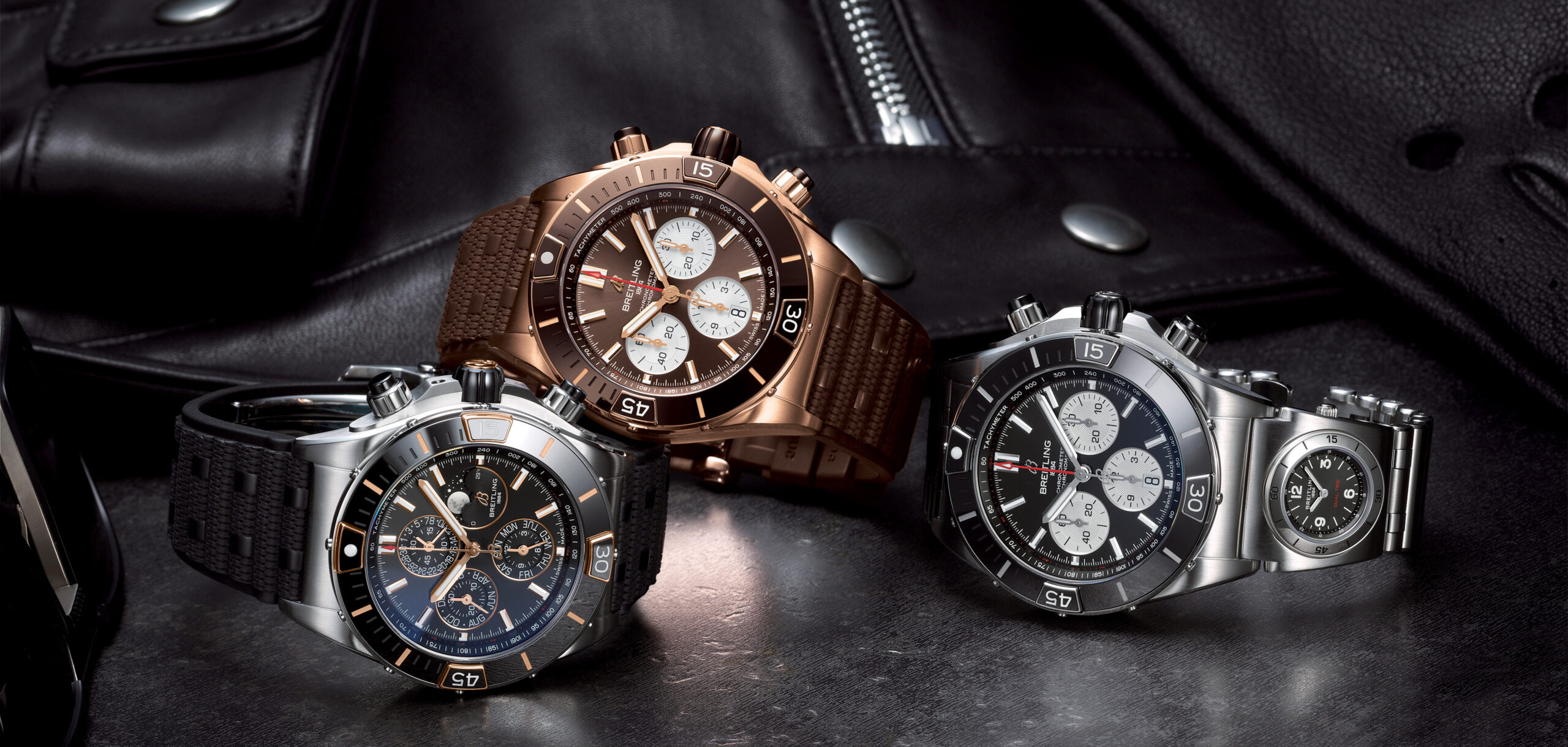
In 2020, the Chronomat made its new debut and quickly became the brand’s bestseller. It is available in various sizes: from very large chronographs with a diameter of 44mm to small (32mm), simple versions with three hands. Two years ago, they were joined by the Chronomat Automatic GMT 40 and the Super Chronomat Automatic 38. The first one has two time zones instead of a chronograph, and is powered by Calibre 32. As a universal sports watch, it will be useful not only when travelling around the world (the 24-hour scale allows you to set the time for day and night), but also for everyday use. In turn, the smaller Super Chronomat Automatic 38 is an option for lovers of smaller watches. It features characteristic ceramic rider tabs on the bezel (decorated with lab-grown diamonds) and a ceramic crown, as well as a rubber strap reminiscent of a Rouleaux bracelet, available only in the “Super” series. The automatic Calibre 17 with a 38-hour power reserve drives the hours, minutes, seconds and the date display at 6 o’clock.
One of the latest versions is that designed by Victoria Beckham, who likes to combine feminine designs with typically masculine ones (we describe this model in this issue’s article about women’s watches).
As is the case with many iconic models, the Chronomat has appeared in many versions and continues to be interpreted in many different ways.
Share this article

LEAVE A COMMENT
You must be logged in to post a comment.