

A tribute to aviation


At this year’s Watches and Wonders trade fair, the Cartier jewellery and watchmaking house presented novelties in its two major and very popular collections: the elegant Santos-Dumont line and the sportier Santos de Cartier line.
With dials in a timeless colour palette that only Maison Cartier can create, the novelties pay homage to the aviation industry and one of its most important figures, the Brazilian aviator and entrepreneur Alberto Santos-Dumont (1873-1932). They are a modern interpretation of the brand’s heritage for men and women who are fascinated by distant horizons, high altitudes and the world of travel.
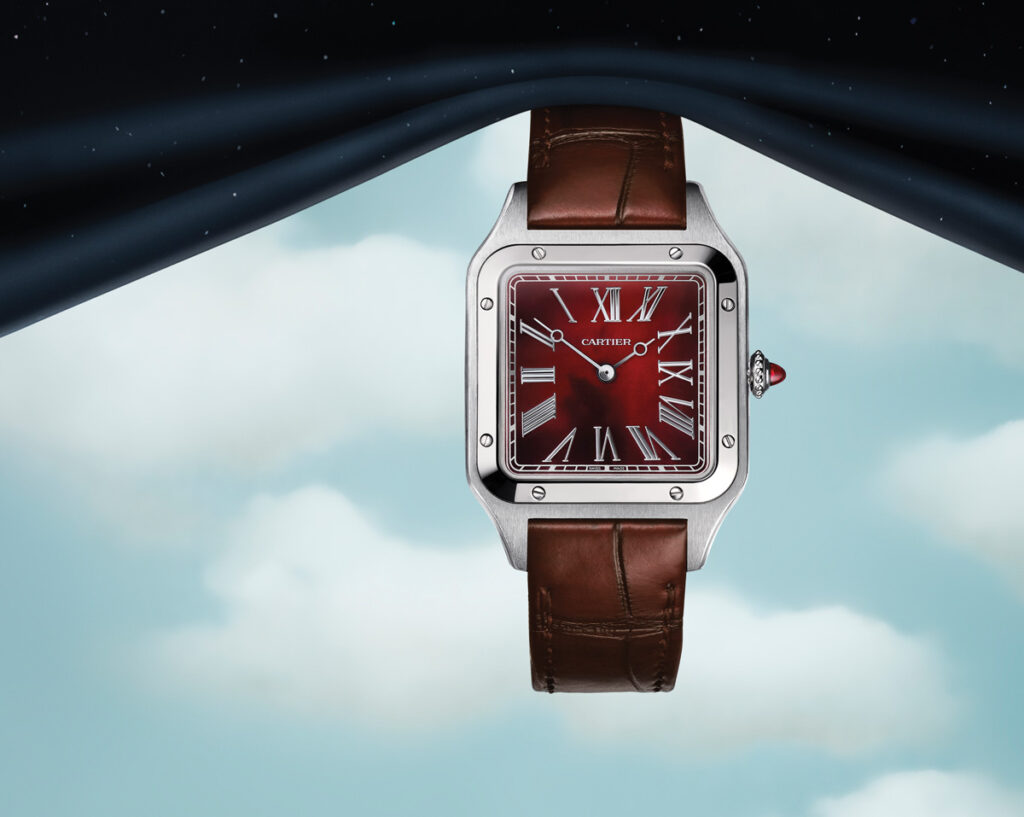
This year, the brand has redefined our perception of time, thanks to two very interesting models. The first is the Santos-Dumont Rewind, which changes the way we traditionally tell the time. Limited to 200 numbered pieces in platinum with a magnificent carnelian dial, this novelty features a mechanical movement with the manual winding calibre 230 MC, whose apple-shaped hands move backwards instead of forwards.
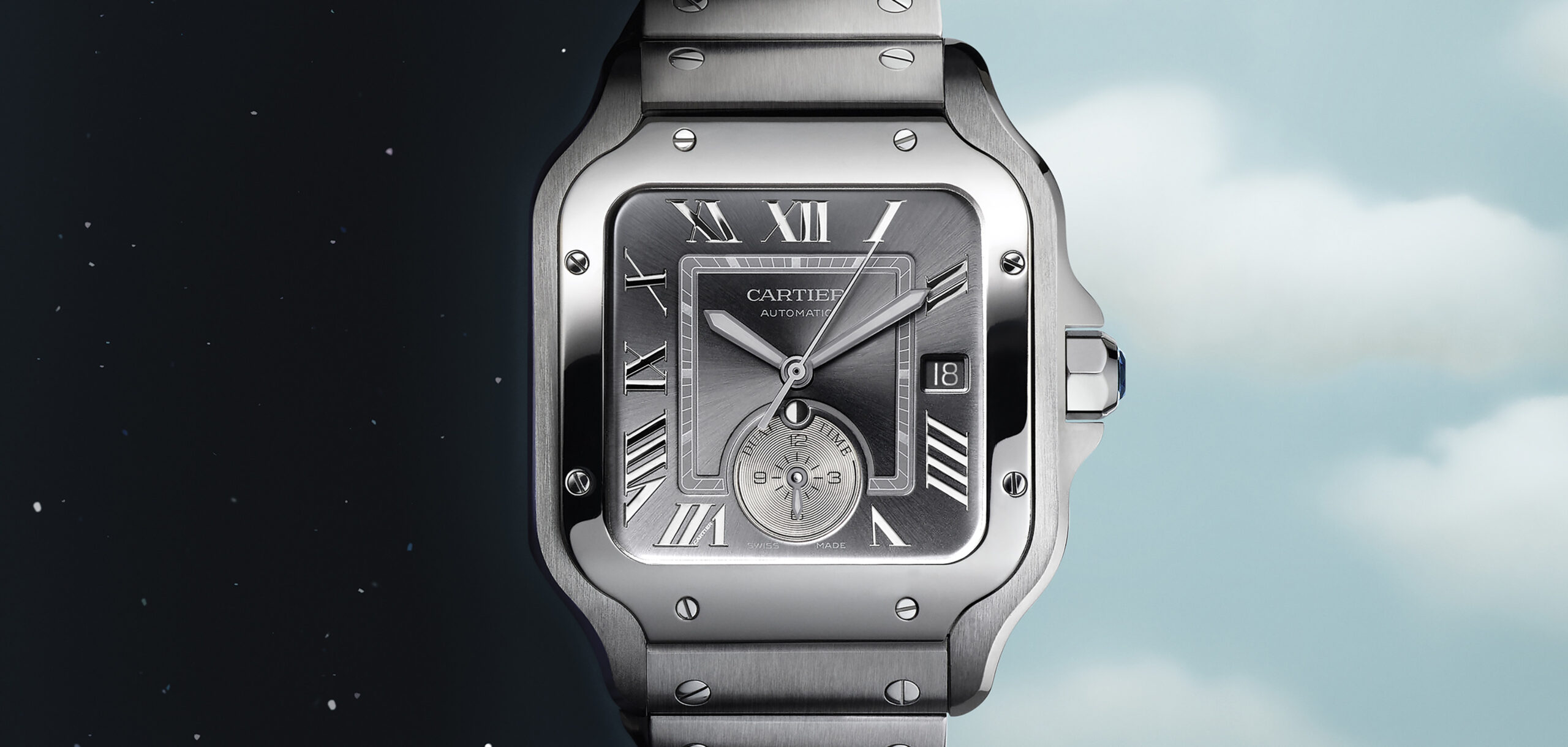
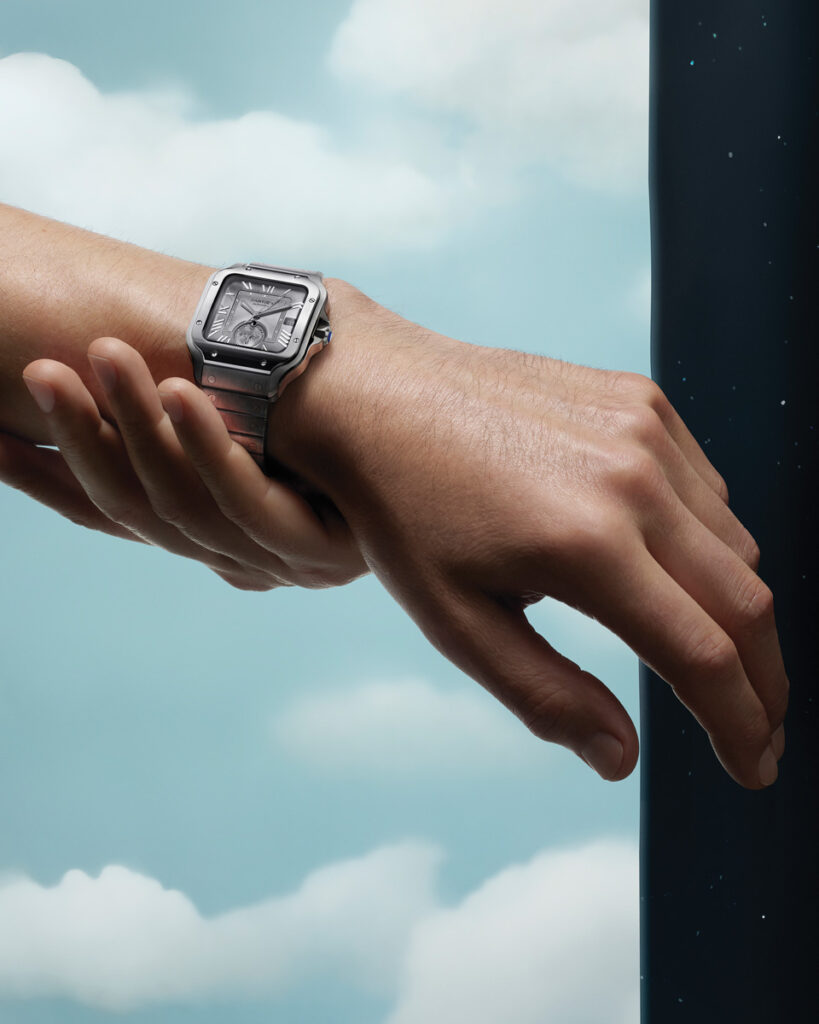
The other major model that caught our eye at the Watches and Wonders trade fair in April was the Santos de Cartier Dual Time watch with a second time zone indicator. This novelty was inspired by Alberto Santos-Dumont’s inclination for travelling. The self-winding mechanical movement allows the wearer to read both the local time and the time in their home country simultaneously by means of a hand in the circular aperture at 6 o´clock with a day/night indicator. The steel model has an anthracite grey dial with a sunray-brushed finish.
However, that’s not all that Cartier has in store for its oldest collection this year. The three exclusive Santos-Dumont models, with Arabic numerals instead of the more usual Roman ones, have beautifully lacquered dials. Olive green is for the platinum edition limited to 200 pieces, the blue peacock dial is combined with a timeless rose gold case and finally the taupe grey stands out thanks to the yellow gold.
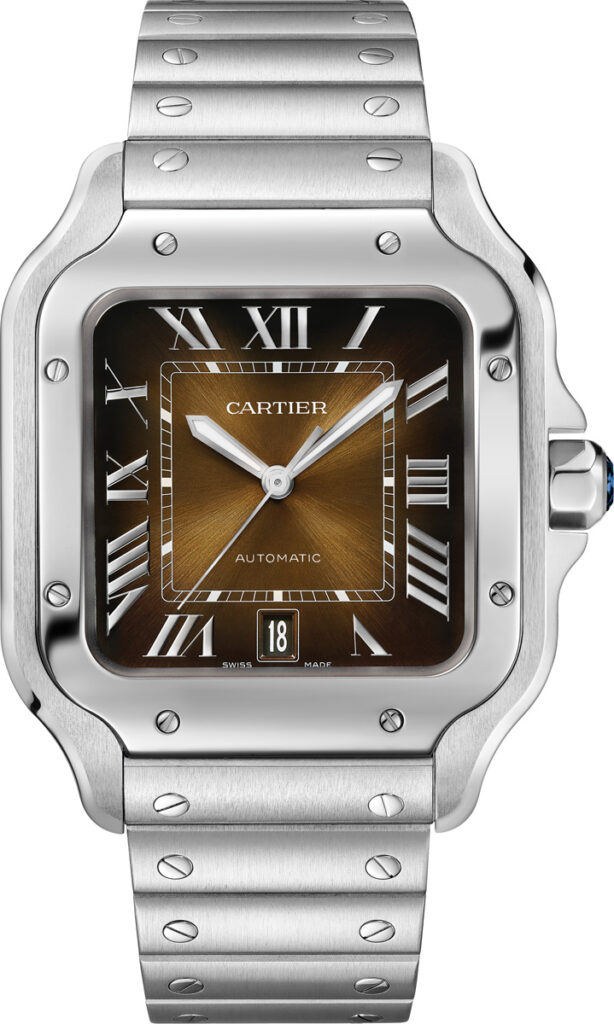
Other models have also been added to the Santos de Cartier collection: a steel model with a yellow gold bezel and an anthracite grey sunray-brushed dial, and two sizes (medium and large) in steel with perfect chocolate brown sunray-brushed dials.
Pioneer of aviation
From the early 20th century until World War II, the brilliant and creative Louis Cartier (1875-1942) held the reins of the Maison Cartier in his hands. Not only did this visionary welcome customers from the ranks of European nobility and wealthy Indian maharajas to his boutique at 13 Rue de la Paix, but he also embraced sport, popularised by the 1900 Paris Olympics. Always with his finger on the pulse of the times, he was particularly interested in aviation, a dynamically developing field.
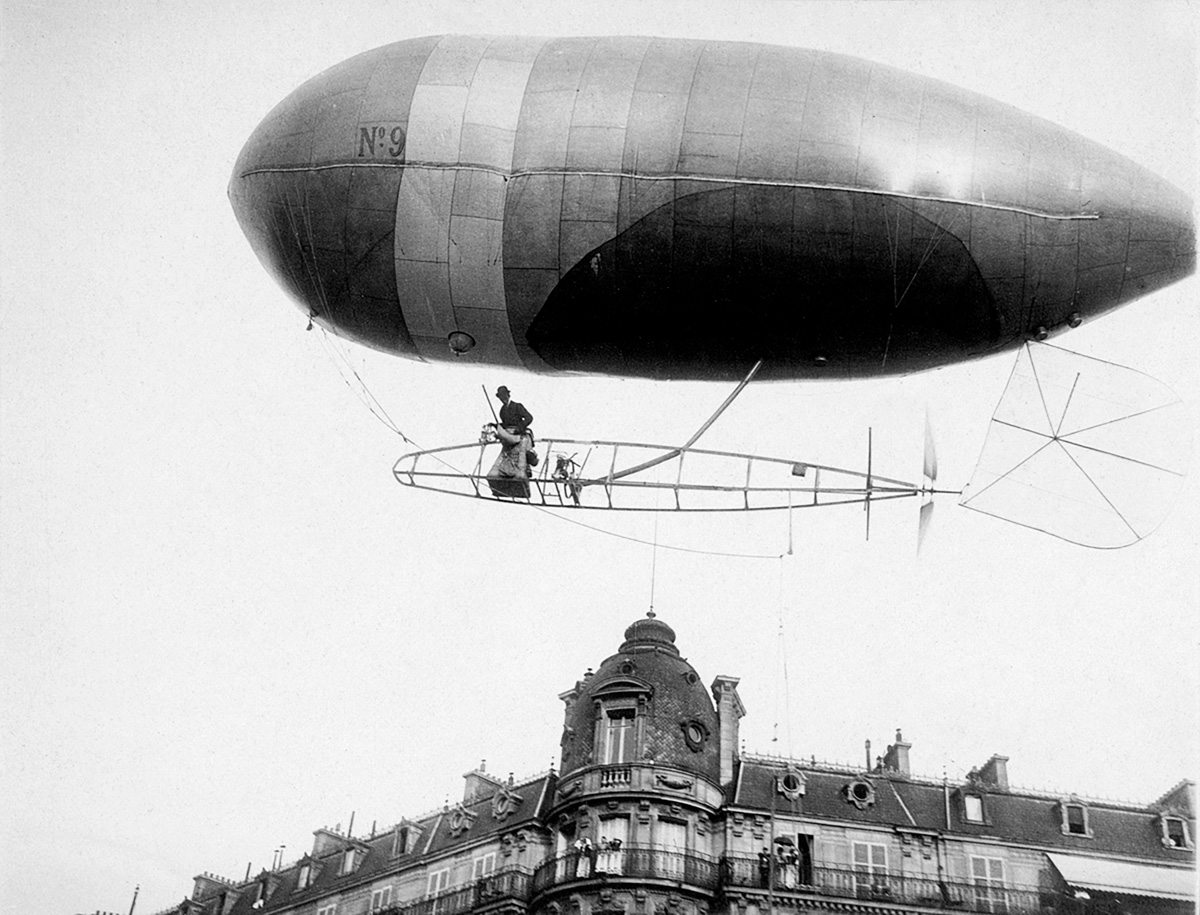
Louis Cartier was a member of the Aéro-Club de France (AéCF), a club of wealthy French businessmen, bankers and former aristocrats. It was here that he met Alberto Santos-Dumont, the extravagant Brazilian aviator, engineer and owner of coffee plantations in his native country.
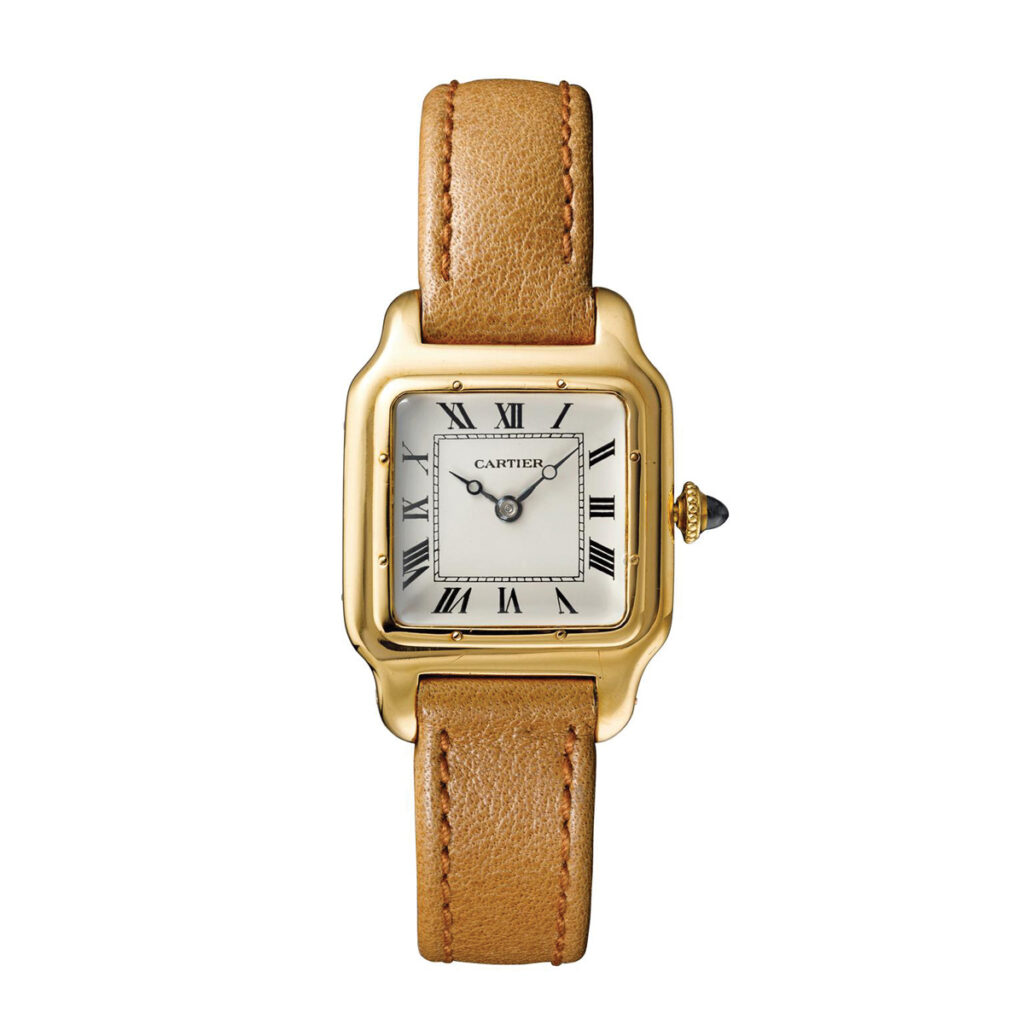
In 1904, he designed a model for his friend, featuring a square case, Roman numerals, clearly inspired by the geometric Parisian boulevards, a model which could be worn on the wrist thanks to a leather strap. The bezel was still decorated with eight visible screws. Another iconic design element of this watch is the inner railway-track minute scale.
Who was first?
The watch, later named Santos, is said to have been the world’s first ever sporty-elegant wristwatch. However, it must be said that Louis Cartier was not the first to come up with the idea of making it easier for pilots to read the time during a flight.
A year earlier, the Wright brothers had already taken off with a similar watch from the Geneva-based manufacture Vacheron Constantin. But unlike the Wright brothers’ watches, Louis Cartier’s model went into production in 1911, of course in very limited numbers each year, but in many versions, including one with an enamel or Bakelite case.
But thanks to its simple design – including the square case, which clearly distinguished the wristwatch from the round pocket watch – it did what no one expected. The watch set a clear trend that other brands started to follow. In 1911, the new models were an unprecedented success at Cartier’s luxury store on Rue de la Paix.
Unfortunately, Alberto Santos-Dumont’s original watch has been lost, and the brand has only archived models produced from 1911 onwards. Some of them have cases made of platinum, a material that Louis Cartier pioneered in watchmaking and jewellery. Today, platinum is reserved for exclusive limited editions of Cartier watches.
After the First World War, Cartier followed up the Santos with the now equally popular Tank model with a rectangular case. Both collections from the pen of Louis Cartier have become emblematic of the house, which today produces watches in a modern manufacture in La Chaux-de-Fonds, Switzerland. Since 2002, some of them have even been equipped with in-house calibres.

Big celebration
The writer Truman Capote, the artist Andy Warhol or the dancer Rudolf Nureyev. The New York elite of the late 1970s had one thing in common besides status and money: in 1979, they became ambassadors for one year for the new Santos de Cartier watch.
The Santos de Cartier was a sporty-elegant watch made of gold and steel, equipped with an ETA movement. The modern watch, introduced a year earlier, in 1978, was an attempt by the French house to overcome the quartz crisis and attract new, younger customers. This was also why the new Santos de Cartier watches were more affordable than the original models.
A celebration of the new design and, above all, of the 75th anniversary of the Santos watch took place on March 14th at the Seventh Regiment Armoury on Park Avenue in New York. During the event, the other invited stars discovered that Rudolf Nureyev had a slightly different model on his wrist. He refused to wear the gold and steel watch that had originally been offered to him, one of the first in this combination of materials that is still popular today. His words “Nureyev does not wear steel” were taken to heart by the brand’s representatives and the star dancer was given an all-gold Santos, about six times more expensive than the steel model. This fact caused a subtle rift among the other talented celebrities. Truman Capote, who already owned seven Cartier watches at the time, told reporters: “I’m a Cartier fan and I’m happy to have another model in my collection. I don’t care if it’s made of steel or gold.”
The new watch has become a hit, a symbol of social status and power. Its popularity is evidenced by the 1987 Oliver Stone film Wall Street, in which it was worn by the ruthless banker Gordon Gekko, portrayed by the American actor Michael Douglas.
The Santos, as evidenced by the brand’s new arrivals this year, is an irreplaceable presence in Cartier’s collections. And we believe it will be no different in another 120 years.

Share this article

LEAVE A COMMENT
You must be logged in to post a comment.